Hot stamping foil is one of the most unforgiving materials in roll-to-roll converting. At just 12–25μm, its multi-layer PET structure—release coat, color layer, aluminum layer, and adhesive—can be permanently damaged by tension fluctuations that would be negligible on thicker films. A slitter that runs acceptably on standard foil may produce micro-burrs and aluminum dust on thin-gauge or holographic materials, and those defects inevitably surface downstream at the hot stamping press as incomplete patterns, edge fuzz, and lost yield.
Selecting the right machine requires looking past headline speed figures and focusing on the parameters that directly govern edge quality and web stability. This guide breaks down the critical specifications for converters and foil manufacturers seeking burr-free cutting and consistent tension control.
Start with Material Reality, Not the Spec Sheet
Hot stamping foil is not a single product. The specific foil type you process most often should dictate equipment priorities.
Standard colored foil is the most forgiving. It tolerates moderate tension variation and performs well with circular-blade shear cutting and basic static elimination.
Laser and holographic foils present the greatest challenge. Their surface carries a fine diffraction microstructure that is easily scratched by any contact. For these materials, air knife (non-contact) slitting becomes almost essential, and every guide roller in the material path should be mirror-polished to prevent microscopic abrasion.
Thin-gauge foil (12–19μm) demands superior tension control. The PET base film stretches permanently if tension runs even slightly high, causing registration errors downstream. If tension runs low, air becomes trapped between wound layers, leading to telescoping and interlayer slippage.
Adhesive-heavy foils tend to gum up cutting edges. Teflon-coated blades and mirror-finish rollers help prevent sticking, while a carefully tuned micro-tension system avoids the stretching that prematurely activates the adhesive.
Before comparing machine models, document your actual material profile: typical thickness range, base film type, surface sensitivity, and the narrowest width you need to produce. Bring this profile to every supplier demonstration and insist on a trial cut with your most challenging material.
Cutting Method: The Decision That Determines Edge Quality
The cutting mechanism directly controls burr formation, dust generation, and blade longevity. Three main approaches exist for hot stamping foil.
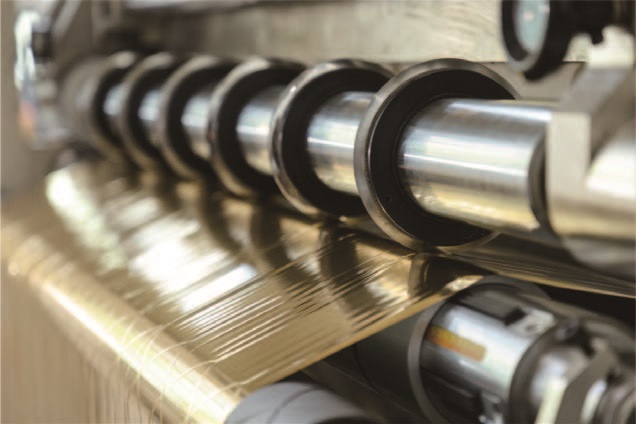
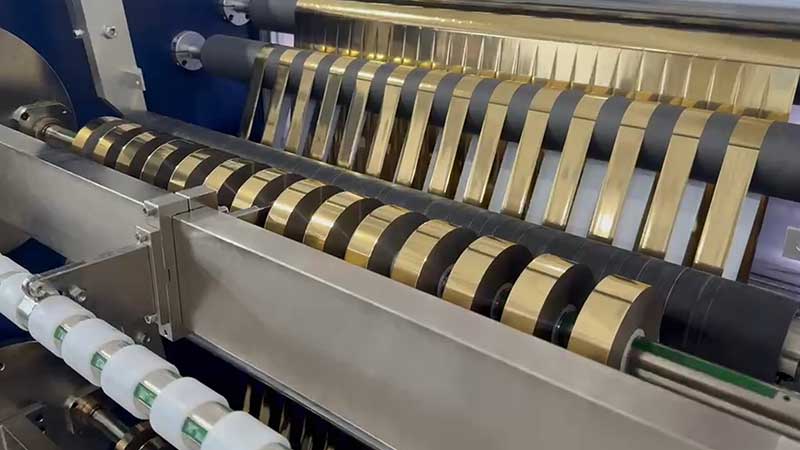
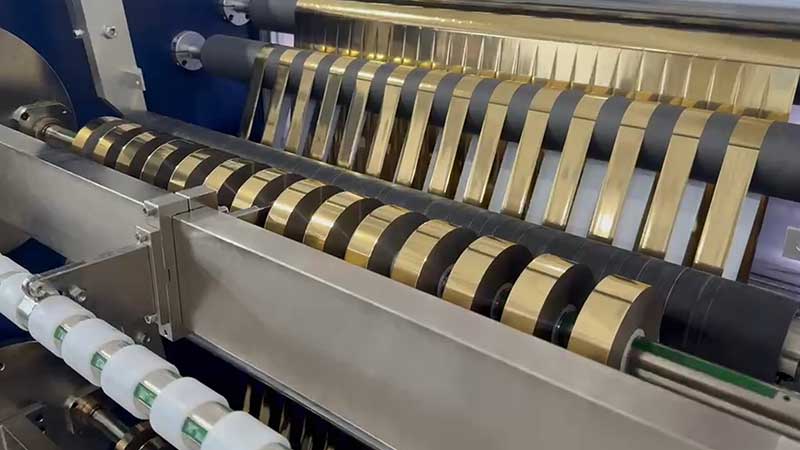
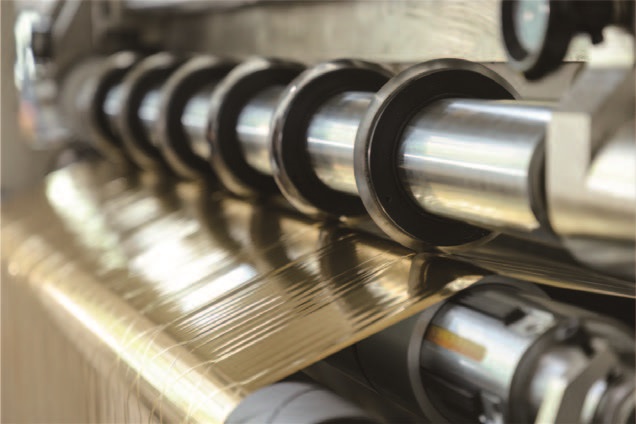
Circular shear cutting remains the industry standard. Upper and lower disc blades act like scissors, producing clean edges with minimal dust. Blade life is relatively long, and the method handles a wide range of thicknesses. The trade-off is higher mechanical complexity—cutter shaft rigidity becomes critical, especially for master roll widths above 800mm where mid-shaft deflection can cause incomplete cuts in the center while over-penetrating at the edges.
Razor blade slitting is the economical option for narrow-width, lower-volume production. However, razor blades generate more dust and burrs on thicker foils, and blade replacement is frequent. For factories producing standard packaging foil in modest volumes, it remains a viable cost-conscious choice.
Air knife (non-contact) slitting uses high-pressure air to separate the material. It eliminates blade-induced scratches entirely, making it the only safe option for laser and holographic foils with delicate surface structures. The drawbacks are higher initial cost and suitability primarily for thinner gauges.
For operations running a mix of standard and specialty foils, a shear-cut machine with quick-change blade assemblies offers the best balance of versatility and edge quality. Regardless of method, blade condition is non-negotiable: a dull blade presses and fractures the foil rather than shearing it cleanly, producing the microscopic burrs and aluminum dust that contaminate finished rolls.
Tension Control: The Invisible Specification That Makes or Breaks Quality
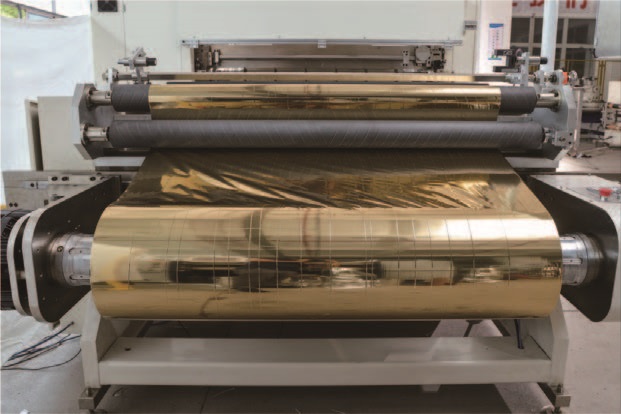
If one technical parameter separates adequate slitters from excellent ones, it is tension control. Hot stamping foil’s layered structure is extremely sensitive to mechanical stress. Slight tension errors cause stretching, wrinkling, or telescoping that only become apparent downstream at the hot stamping press—after the foil has already been converted and shipped.
Open-loop versus closed-loop. Open-loop systems relying on preset values and magnetic particle brakes are acceptable for low-speed, non-critical applications below roughly 100 m/min. They cannot compensate for diameter changes during winding or acceleration/deceleration disturbances. For hot stamping foil, closed-loop servo tension control using tension sensors or floating dancer rollers is the minimum acceptable specification. A quality system maintains tension fluctuation within ±1% to ±3% of the set value; high-end systems achieve ±0.5N precision.
Taper tension is non-negotiable. As the rewinding roll diameter increases, maintaining constant tension causes outer layers to compress inner layers, producing “chrysanthemum core” defects, trapped air, or aluminum layer transfer. Taper tension automatically reduces winding tension according to a preset curve as roll diameter grows. For hot stamping foil, a taper coefficient between 60% and 80% is recommended, with final tension reduced to 40–70% of the initial value. Machines without taper functionality are unsuitable for quality hot stamping foil production, regardless of other specifications.
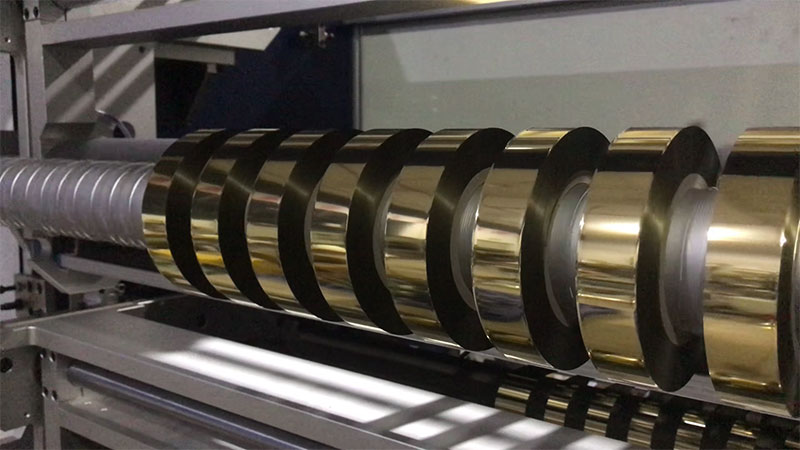
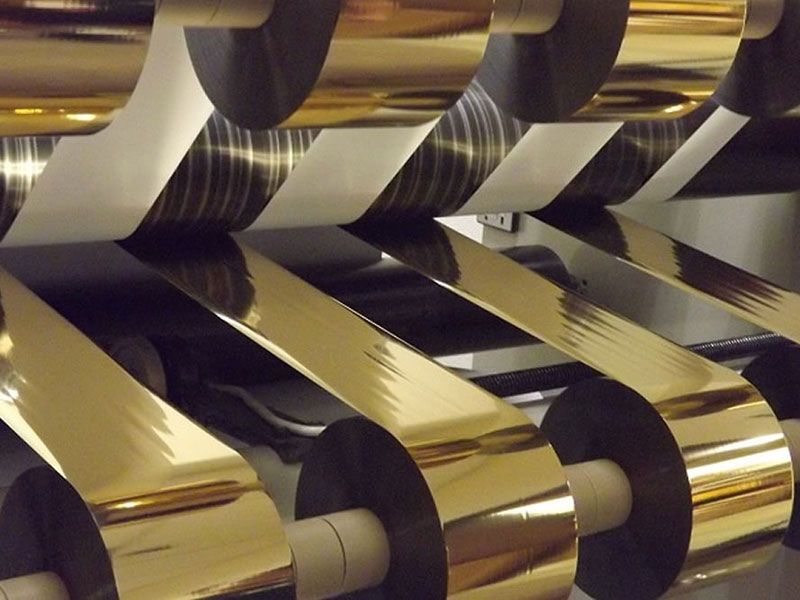
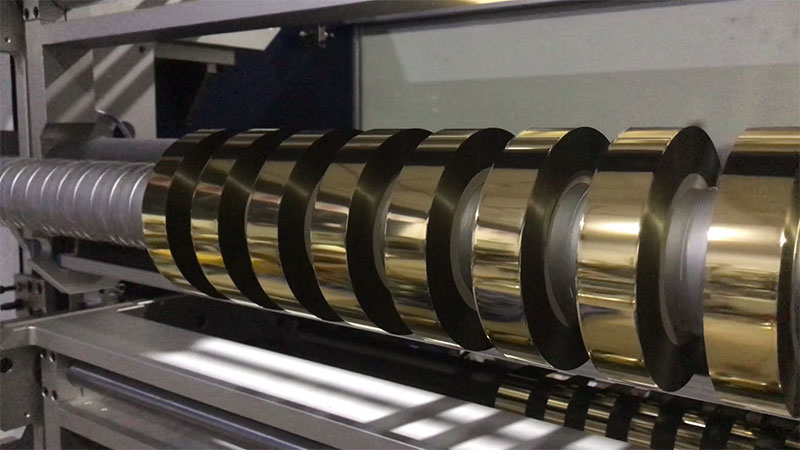
Slip shafts for multi-strip production. When a wide web is divided into multiple narrow strips, each strip no longer behaves as part of a continuous web. Differences in strip width, knife penetration, and winding diameter create unequal tension between individual strands. Without independent slip compensation, some strips become tight while others remain loose. A slipping friction air shaft on the rewinding side ensures stable tension across individual rolls.
When evaluating machines, ask for tension control accuracy specifications and request a demonstration using your thinnest, most tension-sensitive material. Observe whether the finished roll has uniform hardness from core to surface and whether the end faces are clean and straight.
Width Capacity and Tool Positioning Precision
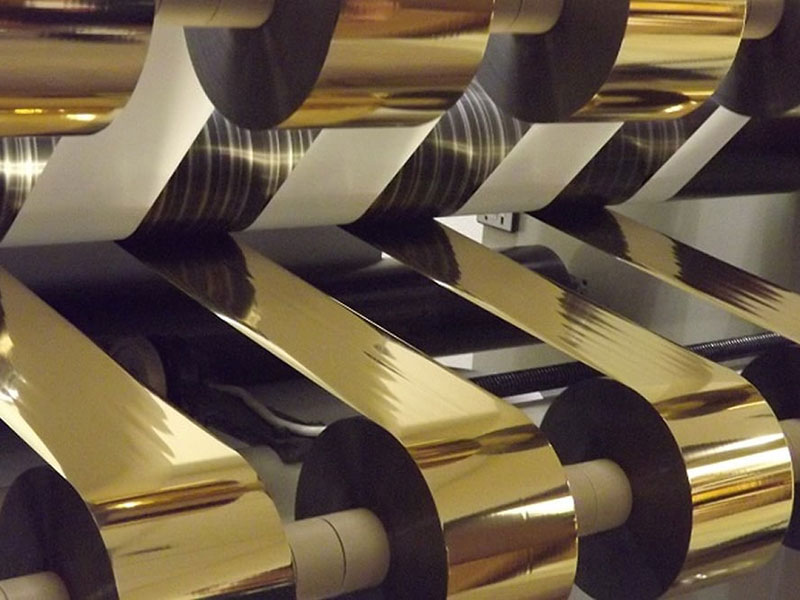
Width specifications have two dimensions that must align with production reality: maximum unwind width and minimum slit width. Most suppliers advertise the former while understating the difficulty of the latter.
For wide-format operations processing master rolls up to 1600mm, frame rigidity and blade shaft diameter become critical. Wider slitting means greater cantilever forces on the blade shaft; if the shaft flexes even slightly under cutting pressure, the center of the web will not cut through while the edges are over-penetrated. Machines in this class require thickened alloy steel wall panels and dynamically balanced, large-diameter blade shafts to maintain stability at speed.
For narrow-strip production below 50mm—common in security threads, decorative bands, and narrow hot stamping lines—priorities shift to tool positioning precision and anti-winding design. Manual locking systems are prone to dimensional drift because uneven clamping forces allow axial movement during operation. Hydraulic locking or high-precision slip shafts are the reliable choice when slit widths are measured in millimeters. If your order profile includes frequent width changes, automatic tool positioning can reduce changeover time from hours to minutes.
A practical benchmark: if your master roll is 640mm and your finished rolls are 20mm wide, the machine must hold ±0.5mm tolerance at that narrow width. Trial cutting with your narrowest material is the only reliable verification.
Automation and Changeover Speed: The Hidden Cost Driver
The reality of hot stamping foil production is that order specifications have multiplied while batch sizes have shrunk. If a single changeover requires more than half an hour of downtime, small batch orders cannot generate profit. When selecting models, changeover speed must be given equal weight to slitting accuracy.
Key automation features to evaluate include:
• Automatic tension calibration that stores material-specific recipes and recalls them at the touch of a button
• Quick-change blade assemblies that allow blade replacement without removing the entire cutter shaft
• Motorized width adjustment on the slitting station for rapid repositioning of knife holders
• Integrated tension monitoring with historical trending to identify drift before it produces scrap
For factories running a high mix of materials and widths, these features often pay for themselves within months through reduced downtime and lower scrap rates on short runs.
A Final Checklist Before Purchase
Before committing to a machine, verify the following with your supplier:
1. Trial cutting with your material. Bring your thinnest, most surface-sensitive foil and your narrowest required width. Inspect the cut edge under magnification.
2. Tension accuracy documentation. Request actual measured fluctuation data, not just the set range. Ask for the control algorithm type (PID with feedback, dancer roller, etc.).
3. Taper tension verification. Confirm the system supports programmable taper curves and demonstrate the effect on a full winding cycle.
4. Blade shaft rigidity specifications. For wide machines, ask for shaft deflection calculations at maximum width and tension.
5. Changeover time demonstration. Time an actual width change from finish to first good roll.
6. Slip shaft performance. For multi-strip production, verify independent tension control across all positions.
The right hot stamping foil slitting machine is not the one with the highest speed rating or the lowest price. It is the one whose tension control, cutting method, and width capacity match your specific material profile and order structure—producing finished rolls that arrive at the hot stamping press with clean edges, uniform hardness, and no hidden defects waiting to surface.
 English
 Deutsch
 Français
 Español
 Português
 日本語
 русский
 한국어
 عربي
 ภาษาไทย
 Tiếng Việt
 Italiano

 Cold Foil Slitter
 Card Print Ribbon Rewinder
 Card Print Ribbon Slitter
 Hot Stamping Foil Slitting Machine
 Holographic Foil Slitter
 Digital Enhancement Foil Slitter
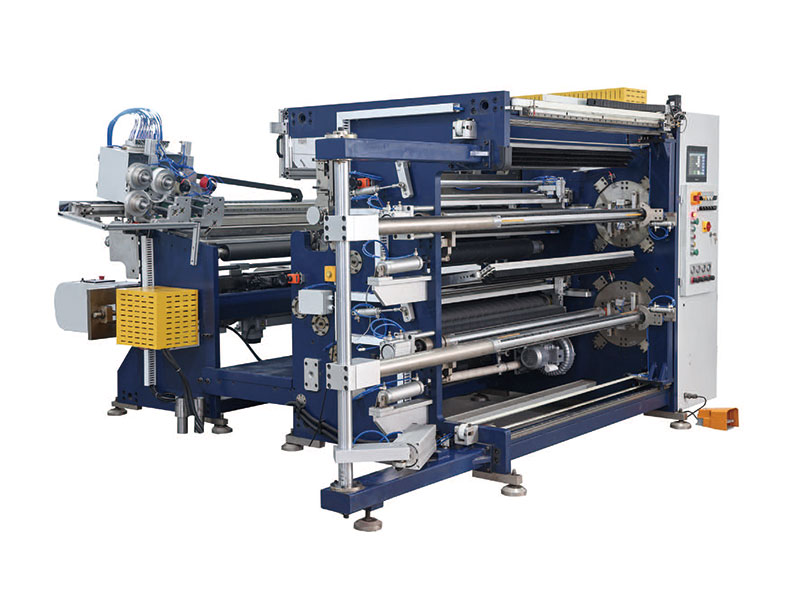 Hot Stamping Foil Slitter RSDS7H 1350 PLUS
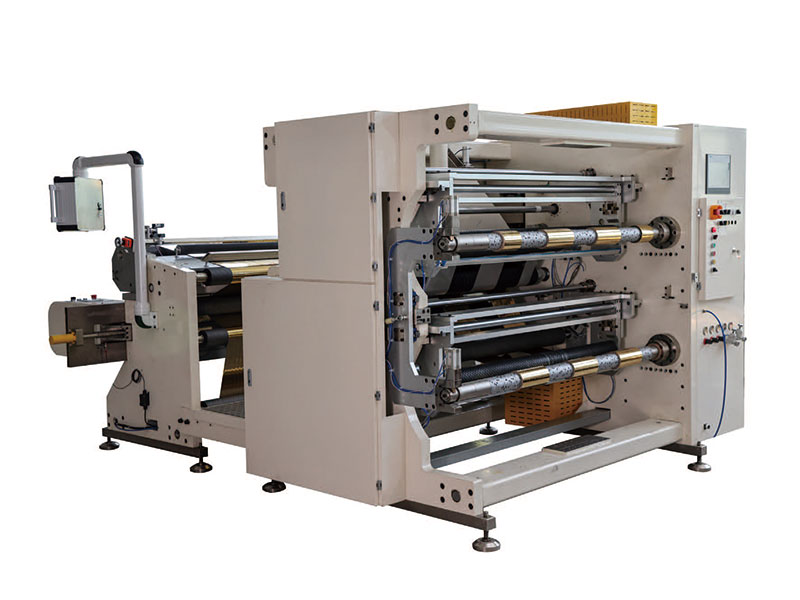 Hot Stamping Foil Slitter (RSDS7H) 1350