The pursuit of zero-defect foil has hit a physical wall. At 6 microns, traditional tension control is no longer a tuning parameter—it is the difference between flawless rolls and irreversible waste.
For decades, hot stamping foil slitting followed a predictable logic: run the web as tight as safely possible, rely on operator experience, and accept a certain scrap rate on ultra-thin grades. That logic collapses at 6μm. At this thickness, the foil has virtually no elastic buffer—elongation at break is well under 1%, meaning any tension spike that a PET film would absorb as harmless stretch will permanently deform or tear the foil. The window between “too loose to track” and “too tight to damage” narrows to a few newtons. Traditional PID tension loops, with response times of 200–500 milliseconds, simply cannot operate inside that window at modern slitting speeds.
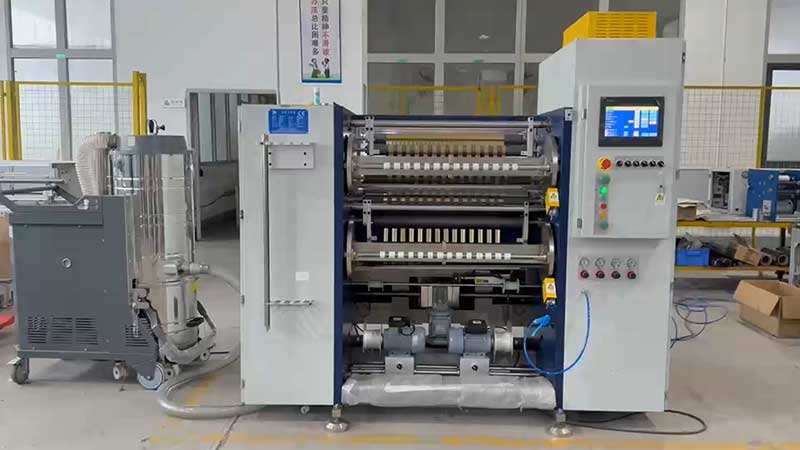
The Anatomy of a Wrinkle at 6 Microns
Wrinkles in ultra-thin foil are rarely caused by steady-state tension error. They are transient events. A splice passes through the cutter at 500 m/min. The unwind diameter crosses a calculation threshold. The machine accelerates from idle to full speed in three seconds. Each of these events injects a tension disturbance that propagates through the web path in under 50 milliseconds. A conventional control system reacts after the disturbance has already buckled the foil between the slitting shaft and the rewind mandrel. Once a crease forms in 6μm aluminum or transfer foil, it cannot be recovered. The defect is locked into the finished roll.
Research from the Association for Roll-to-Roll Converters confirms the severity: aluminum foil at typical handling tensions can exceed critical misalignment angles at deviations as small as 0.1 mm per meter of span, triggering slack edges and shear wrinkles that are 20 times more likely than with polyester webs. The machine does not need to be badly misaligned to ruin a roll. It only needs to be slow to correct.
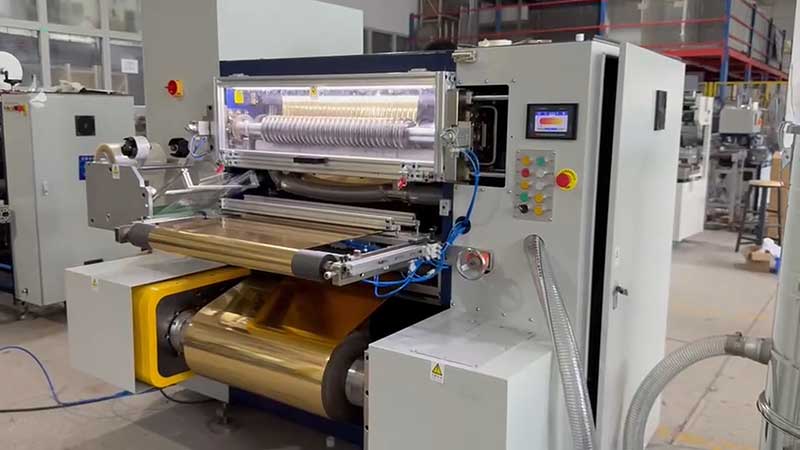
What Millisecond Control Actually Changes
The shift to millisecond-level tension adjustment is not an incremental improvement in PID tuning. It is an architectural change built on four converging technologies.
Direct-drive torque motors eliminate the reducer backlash and elastic coupling deformation that introduce mechanical lag. By integrating the motor rotor directly with the rewind and unwind reels, the mechanical time constant on the unwind side drops from roughly 80 milliseconds to 12 milliseconds. With high-resolution encoders, the delay from control command to actual torque output can be held under 5 milliseconds.
Feedforward model prediction moves the controller from reactive to anticipatory. Rather than waiting for a tension sensor to detect an error, the system calculates the torque change required for an upcoming acceleration ramp, splice passage, or diameter transition—and applies it before the disturbance reaches the web. Field data from high-end slitting trials shows the difference: at 500 m/min, a conventional dual-loop system overshoots tension by approximately 3.5N and takes 400 milliseconds to recover. The feedforward architecture limits overshoot to 0.8N with an 80-millisecond recovery.
Low-inertia floating rollers provide a mechanical first line of defense. A pneumatic float roller with a low-friction cylinder acts as a physical tension buffer, absorbing energy spikes within 8–15 milliseconds—before the electronic control loop has even processed the sensor signal. Position feedback from the roller updates at sampling rates above 2 kHz, giving the controller a high-resolution view of tension dynamics that a load cell alone cannot provide.
Real-time taper adaptation addresses the slowest but most persistent source of wrinkles: the roll build itself. As the rewind diameter grows, the tension setpoint must decrease along a profile that accounts for the material’s compressibility, the nip pressure, and the trapped air between layers. For 6μm foil, a fixed taper slope is insufficient. The system must recalculate the target tension continuously, holding the inner wraps in firm contact without crushing them and keeping the outer layers from going slack.
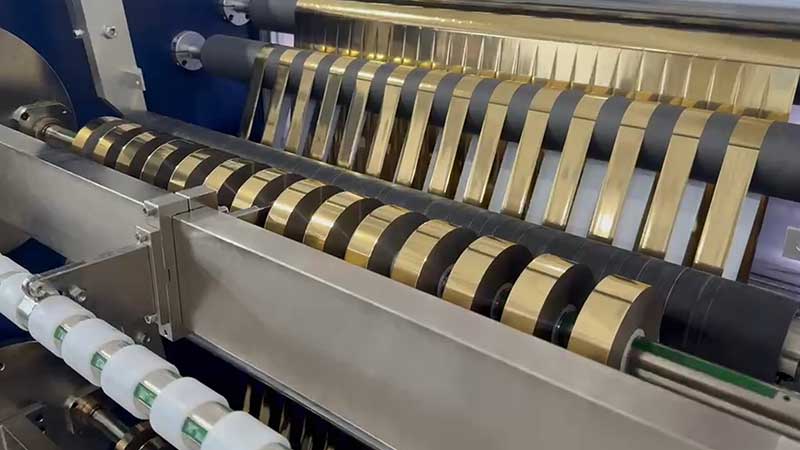
The Commercial Consequence
The practical result is that a slitting machine with millisecond tension control can hold finished roll quality on 6μm foil that would be unattainable on a conventional platform. Edge burrs disappear because the foil is never momentarily overloaded against the cutter. Winding density remains uniform from core to surface because the taper profile tracks the actual roll condition rather than a preset curve. Most importantly, the scrap rate on ultra-thin grades drops from a routine cost of doing business to an exception that signals a genuine mechanical fault rather than a control limitation.
For converters running hot stamping foil for security printing, high-end packaging, or transfer applications where a single wrinkle renders thousands of meters unusable, this distinction is not technical trivia. It is the operating margin.
The New Standard
The industry is already converging on this architecture. Equipment suppliers serving the hot stamping foil market now position millisecond tension response as a defining capability rather than an optional upgrade, with direct-drive platforms and feedforward control loops becoming the reference point for machines capable of handling 4–6μm film at production speeds. The question is no longer whether millisecond control is necessary for ultra-thin foil. It is whether a slitting machine without it can credibly claim to serve the hot stamping market at all.
 English
 Deutsch
 Français
 Español
 Português
 日本語
 русский
 한국어
 عربي
 ภาษาไทย
 Tiếng Việt
 Italiano

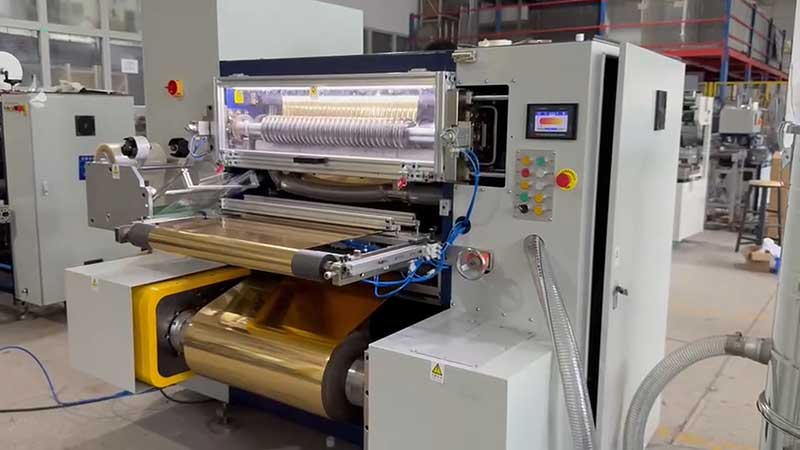
 Cold Foil Slitter
 Card Print Ribbon Rewinder
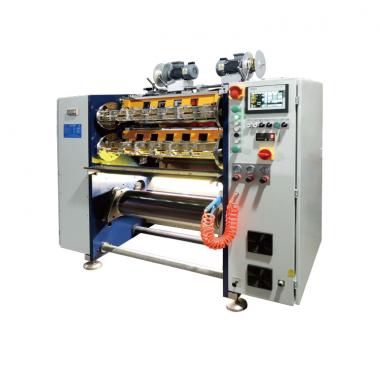 Card Print Ribbon Slitter
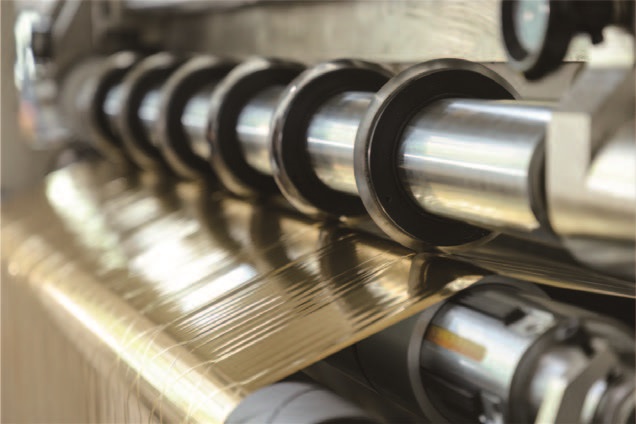 Hot Stamping Foil Slitting Machine
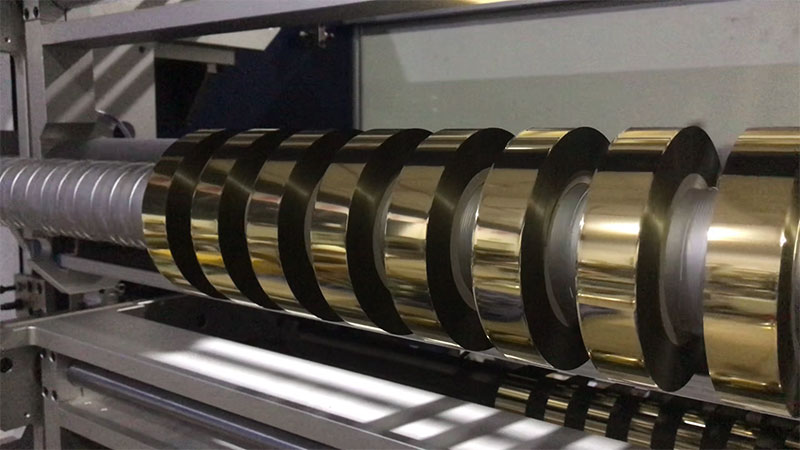 Holographic Foil Slitter
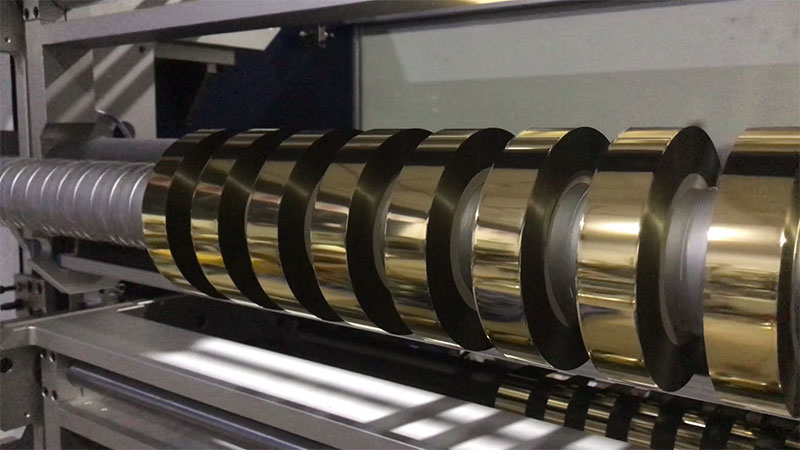 Digital Enhancement Foil Slitter
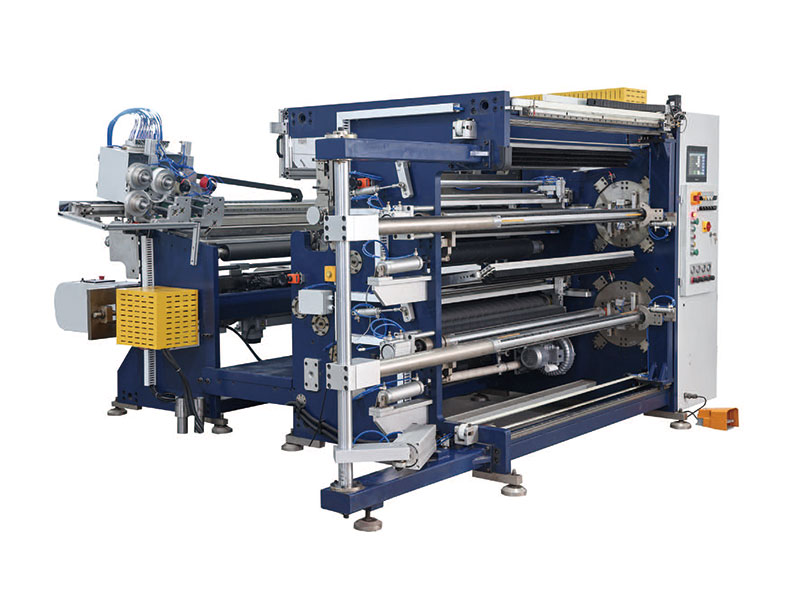 Hot Stamping Foil Slitter RSDS7H 1350 PLUS
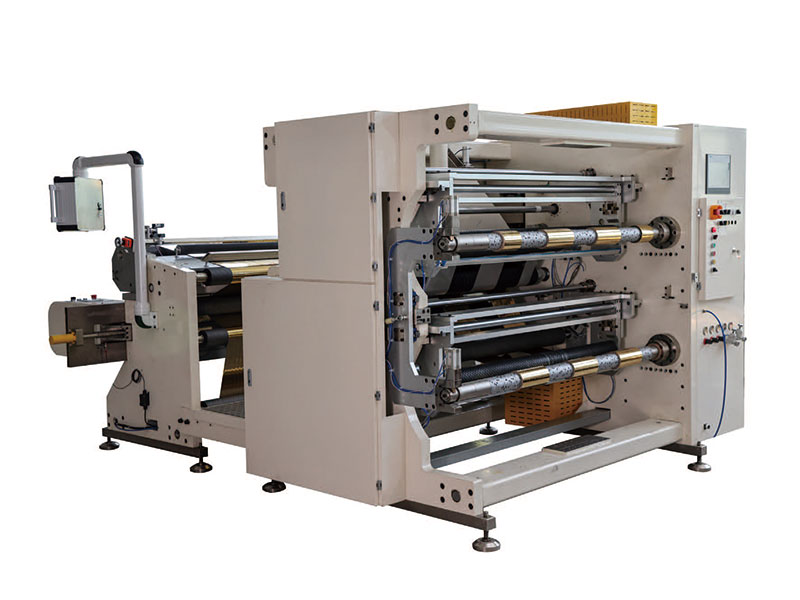 Hot Stamping Foil Slitter (RSDS7H) 1350