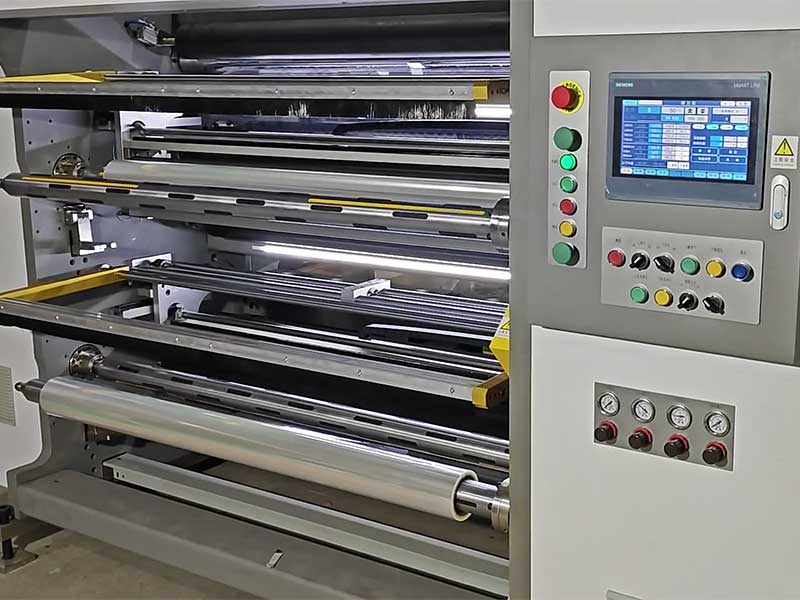
Scratch defects in the paint protection film slitting process have long been a hidden bottleneck restricting finished product yield and brand reputation. The high elasticity and softness of TPU substrate make it far more sensitive to guide roller contact, tension fluctuations, and electrostatic adsorption than ordinary window film. A micron-level scratch, after film application and light refraction, may be magnified into a visible defect. Systematic process upgrades around four paths—"soft contact, precise tension, zero static electricity, and micro-gap"—are the key to suppressing scratch-type defects from the hundreds-of-square-meters level to the tens-of-thousands-of-square-meters level.
I. Analysis of Scratch Sources: Hard Contact, Tension Instability, and Particle Abrasion
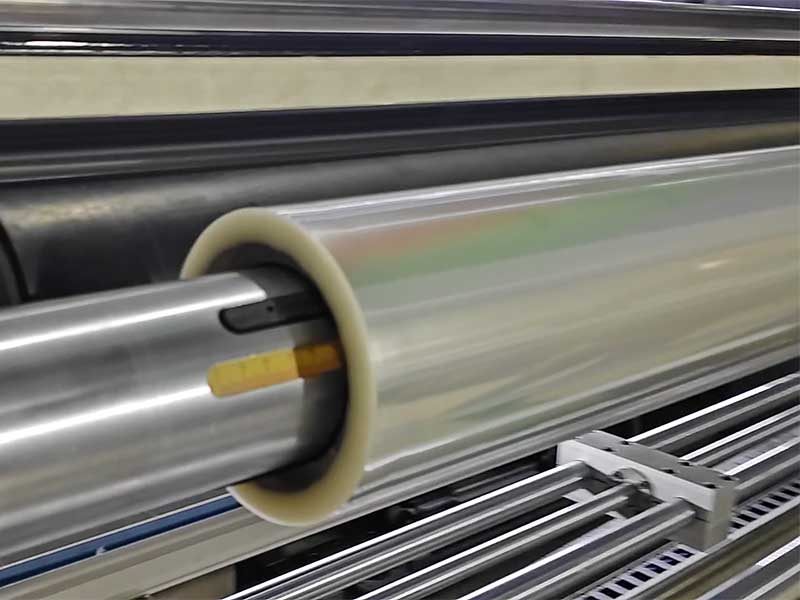
The causes of scratches in paint protection film slitting can be attributed to three types of physical mechanisms. The first is hard-contact scraping by guide rollers: if the surface of traditional chrome-plated metal rollers has micro-burrs, wear, or foreign matter adhesion, continuous or intermittent linear scratches will form when the film surface passes at high speed. TPU material has low surface energy, and its friction coefficient is relatively high when in contact with metal roller surfaces, so even a slight speed difference is enough to cause surface damage.
The second is slipping and wrinkle friction caused by tension fluctuations. TPU is extremely sensitive to tension. A sudden change in tension in the unwinding section will cause the film material to slip instantaneously on the guide rollers, while excessive tension in the winding section will cause interlayer compression, creating relative sliding between the film surface and the roller surface and forming fine friction scratches. The third is the "sandpaper effect" of particles adsorbed by static electricity. After TPU becomes charged through friction, it adsorbs dust and cutting chips in the air. Particles are trapped between the film and the guide rollers and, under pressure, cause abrasive damage to the film surface. Such scratches often appear in intermittent dotted-line distribution.
II. Guide Roller System Upgrade: From Hard Contact to Soft Contact and Air Film Isolation
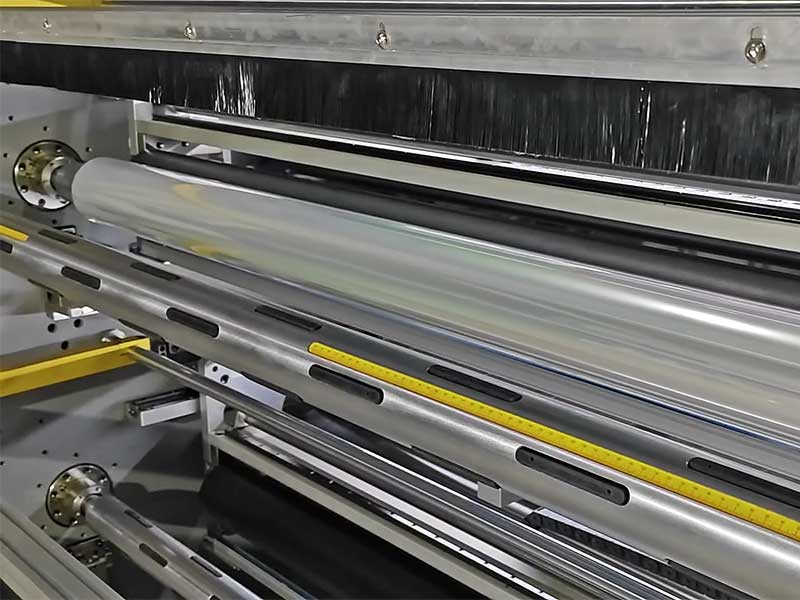
Guide rollers are the first barrier of film surface contact, and their surface characteristics directly determine the risk level of scratches. The upgrade plan should implement differentiated surface treatment across the entire film path: for guide rollers in direct contact with the TPU coating, use a high-precision mirror-polished stainless steel substrate plus PTFE or ceramic coating to minimize the friction coefficient, while using the coating's anti-stick properties to prevent TPU from being torn due to local adhesion during high-speed operation. For traction sections that require applied pressing force, switch to polyurethane rubber-covered rollers with Shore hardness of 40 to 60, replacing rigid squeezing with elastic deformation and eliminating the possibility of point-like pressure marks evolving into scratches.
In high-end models, the introduction of air-floating guide rollers provides a more thorough solution. Compressed air forms a micron-level air film between the roller surface and the film material, achieving physically non-contact conveyance and reducing the probability of mechanical friction scratches to zero. Although this configuration increases equipment cost, for high-value-added paint protection film products, its input-output ratio is reasonable in light of yield improvement.
III. Tension Control Reconstruction: Coordination of Servo Closed Loop and Taper Decreasing
The precision of tension control directly maps to the amount of relative sliding between the film surface and the guide rollers. The core of the upgrade is to replace open-loop or semi-closed-loop control with a fully servo closed-loop tension system: the unwinding, traction, slitting, and winding sections are driven by independent servo motors, combined with millisecond-response tension sensors, to converge fluctuation amplitude to a very small range around the set value. To meet TPU's "micro-tension" requirements, the addition of low-inertia floating rollers can absorb instantaneous tension peaks and prevent the film surface from stretching or loosening and slipping due to sudden tension changes.
The key upgrade in the winding section lies in the refined calibration of the taper tension decreasing algorithm. As the roll diameter increases, if constant tension is maintained, the cumulative pressure of the outer film on the inner layers will cause plastic deformation and even adhesion of the coating. The system needs to set the decreasing curve according to the compression modulus of TPU, so that the tension gradient from the roll core to the outer layer transitions smoothly, ensuring tight winding without tunneling while avoiding hidden pressure marks caused by interlayer compression.
IV. Static Elimination and Online Cleaning: Cutting Off the Source of Particle Scratches
Static electricity does not directly scratch the film surface, but it "fixes" particles from the environment on the contact surface between the film and the rollers, turning otherwise harmless dust into an abrasive medium. The upgrade plan should set up two-stage static neutralization nodes before and after slitting: immediately after unwinding, use AC static elimination bars to neutralize the initial charge on the film surface; after slitting and before winding, use pulsed DC ion air knives to treat the newly exposed surface, ensuring that the static voltage drops below the safety threshold.
Linked with static elimination is the combination of non-contact dust removal and contact tack removal. High-pressure ion air knives blow away loose particles before the film surface enters the slitting zone, while micro-adhesive dust-removal rubber rollers adsorb residual fine dust through low-pressure contact. The sequence of the two should be determined according to line speed and particle load. Generally, ion air pre-cleaning followed by tack roller final cleaning is preferable to avoid premature saturation of the tack rollers.
V. Slitting Tools and Gap Control: A "Gentle Cut" with Micron-Level Precision
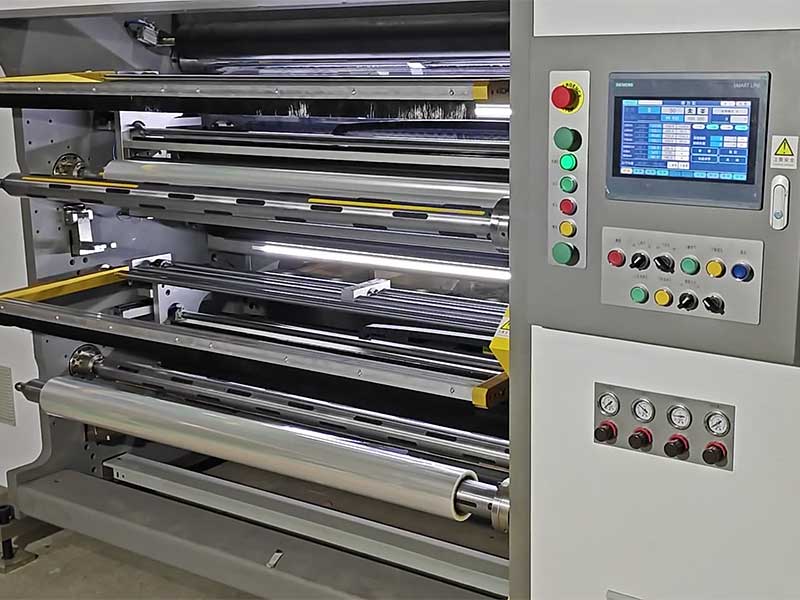
The particularity of paint protection film slitting lies in the fact that it must cut through high-toughness TPU substrate and self-healing coating while preventing the blade edge from touching non-cutting areas. The current mainstream upgrade direction is to replace traditional crush cutting with upper and lower circular disc shear slitting, using the scissors principle to reduce impact on the coating and produce smooth cuts without burrs. Tool materials use ultra-fine tungsten carbide or diamond coating, significantly extending the sharpness retention cycle of the blade edge and reducing cut burrs and film edge pulling caused by tool wear.
The matching gap between the knife groove roller and the upper circular knife is a hidden key to scratch control. If the gap is too large, the film material lacks support at the cutting point and vibrates or sinks, and the knife tip may scratch the lower film surface; if the gap is too small, tool wear accelerates and friction heat increases. The upgrade plan needs to be equipped with a micron-level electric gap adjustment mechanism, combined with a high-rigidity knife shaft and ceramic bearings to suppress micro-vibration during high-speed operation, ensuring that the engagement amount remains stable in continuous production. For high-end product lines, ultrasonic slitting uses high-frequency micro-vibration to make cutting resistance approach zero, fundamentally eliminating the stress impact of mechanical shearing on the film surface, and is an advanced option worth attention.
VI. Verification and Benefits: From Defect Rate to Comprehensive Yield
The effectiveness of process upgrades needs to be verified with quantitative indicators. An online linear array CCD optical inspection system combined with AI classification algorithms can identify and mark scratches, white spots, crystal points, and other defects in real time, shifting quality judgment from sampling to full inspection. The upgraded target indicators should be set as follows: scratch-type defect rate reduced from the hundreds-of-square-meters level to the tens-of-thousands-of-square-meters level (within 0.01%), slitting width tolerance controlled within ±0.1mm, and winding end face flatness meeting the requirements of no "bulging ribs" and no "telescoping."
Direct benefits are reflected at three levels: material savings brought by yield improvement, especially significant for TPU paint protection film with relatively high unit prices; reduction in after-sales compensation and brand damage due to lower customer complaint rates; and capacity release brought by increased slitting speed—when tension control and anti-scratch systems are sufficiently stable, the production line can maintain the same quality level at higher speeds, diluting unit processing costs. The essence of anti-scratch process upgrading is to transform the slitting machine from a rough tool that "can cut" into precision equipment for "lossless separation," protecting the entire value of paint protection film from master roll to finished product at the scale of microns and milliseconds.
 English
 Deutsch
 Français
 Español
 Português
 日本語
 русский
 한국어
 عربي
 ภาษาไทย
 Tiếng Việt
 Italiano