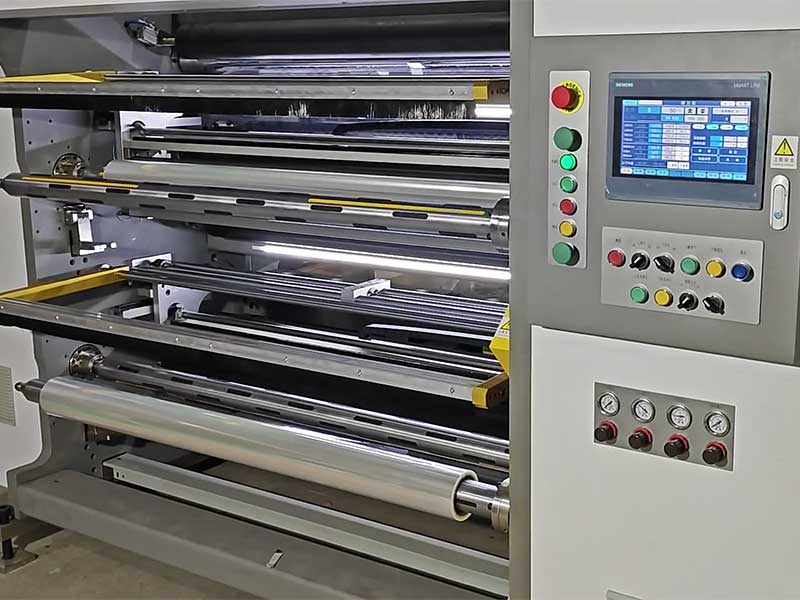
Many processing plant owners ask: if a Solar Film slitting machine can also cut TPU paint protection film, why buy a dedicated paint protection film slitting machine? Where exactly does the price difference go?
Let's get the conclusion straight first: a Solar Film slitting machine cutting TPU is "can cut" but "can't cut well"; a paint protection film slitting machine is "designed specifically for TPU's temperament." The core differences are not in the mechanical structure itself, but in targeted modifications across four dimensions: tension control precision, cutting tool configuration, temperature control system, and anti-scratch design. Using a Solar Film machine to cut TPU means, at best, burred cuts and scratched film surfaces; at worst, entire rolls scrapped.
Difference 1: Tension Control — Solar Film Needs "Stable," TPU Needs "Extremely Low and Stable"
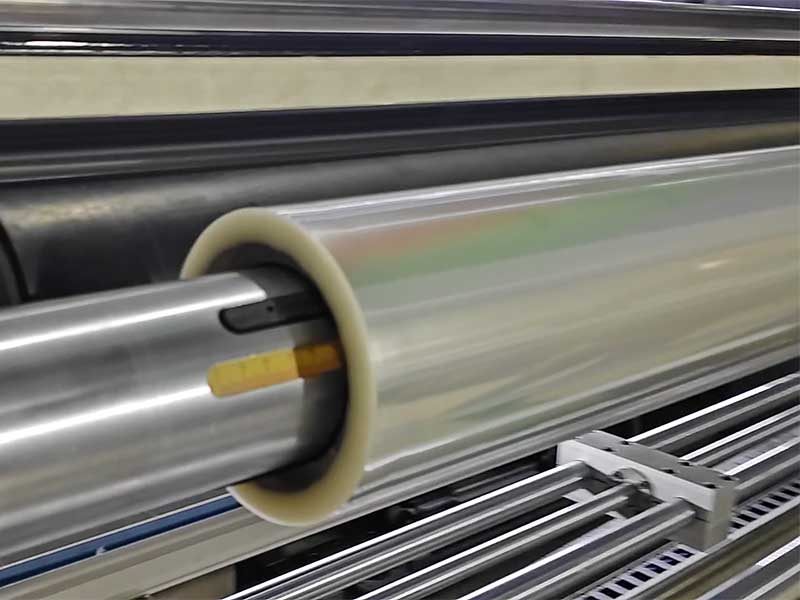
The substrate of Solar Film is PET, which is relatively stiff, and tension can be kept stable within a conventional range during slitting. Solar Film slitting machines typically use constant tension or taper tension control, with the goal of preventing PET from being stretched and deformed.
But TPU's elastic modulus is in a completely different league from PET. The high elasticity of TPU paint protection film means any tiny tension fluctuation gets amplified—once the film surface is stretched, it cannot spring back to its original shape, and the finished edges develop "wavy edges," making edge wrapping impossible during installation. The industry pass line is a stretch rate controlled below 0.2%.
The paint protection film slitting machine's solution is segmented independent servo drives: unwinding, traction, and rewinding are each independently controlled, paired with millisecond-response tension sensors, and some high-end models support extremely low tension ranges of 0.1–5N. Solar Film slitting machines typically don't need to reach this level—forcing a Solar Film machine's lower tension limit to cut TPU often means the film is already deformed before reaching a stable operating range.
There's also an easily overlooked detail: TPU rewinding must incorporate taper decrement logic. As roll diameter increases, tension must automatically decrease along a curve; otherwise the inner layers get compressed tighter and tighter, forming a collapsed roll that's loose inside and tight outside. While Solar Film slitting machines also have taper tension, the precision and dynamic response requirements are not in the same class.
Difference 2: Cutting Tool Configuration — Solar Film "Cuts Through," TPU Needs "Clean Cuts Without Adhesion"
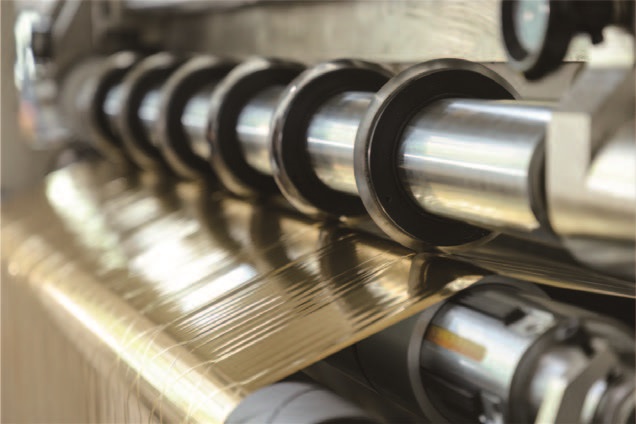
The mainstream cutting tools for Solar Film slitting are diamond-coated circular blades or ceramic blades, sufficient for PET substrates and magnetron sputtered layers. But TPU is a different story: with high-elasticity materials, an ordinary circular blade isn't "cutting" but "tearing," and burrs and stringing at the cut edge are almost inevitable.
The paint protection film slitting machine's tool upgrades focus on two points: specially made tungsten steel circular blades paired with automatic blade pressure micro-adjustment, ensuring the edge can cleanly penetrate high-elasticity materials without tearing. The more advanced solution is ultrasonic slitting, where high-frequency micro-vibration makes cutting resistance near zero, completely preventing adhesive overflow and coating cracking.
The precision requirements for the blade groove roller gap also differ. When slitting TPU, the engagement amount of upper and lower blades needs to be precise to the micron level—too large a gap and the film vibrates at the cutting point; too small and wear accelerates. Solar Film slitting machines' blade gap adjustment precision is typically designed to PET's tolerance, and when applied to TPU, the tolerance band may simply not be sufficient.
Difference 3: Temperature Control System — Solar Film Can Skip It, TPU Can't
This is the most easily overlooked difference. During Solar Film slitting, friction-generated heat is not the main issue—PET's softening point is far above the slitting temperature rise. So Solar Film slitting machines typically don't have cooling systems, relying on natural heat dissipation.
But TPU gets sticky when heated. During slitting, even if friction at the blade edge only raises local temperature to forty or fifty degrees, the adhesive layer begins to soften, the cut edges stick together, and after rewinding the layers adhere to each other—the entire roll is scrapped. The paint protection film slitting machine's standard configuration is a cooling roller (with chilled water) or air cooling system, with the goal of keeping the film surface temperature at the cutting point below 40°C.
This difference directly reflects in equipment cost and structural complexity. The cooling unit that's omitted on a Solar Film machine is not only standard on a paint protection film machine but also involves piping layout and coordination with temperature control logic.
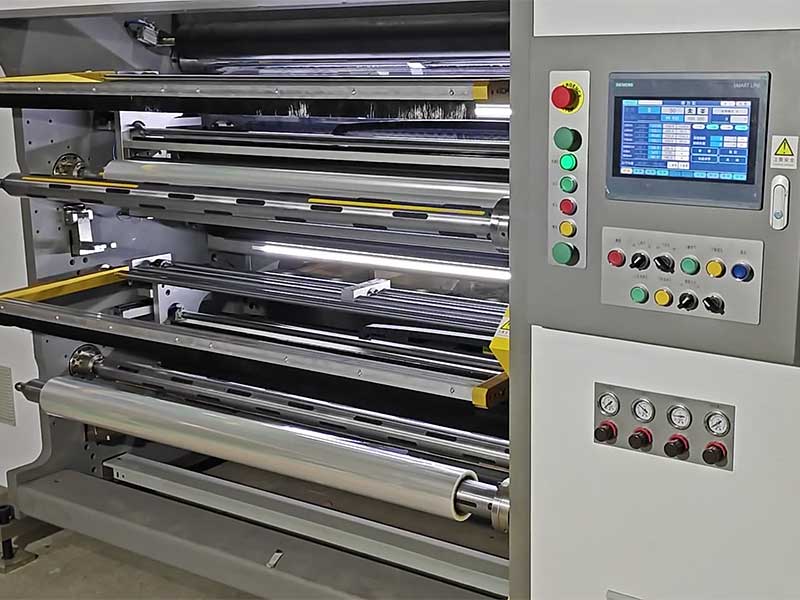
Difference 4: Anti-Scratch Design — Solar Film's "Good Enough" Is "Not Enough" for TPU
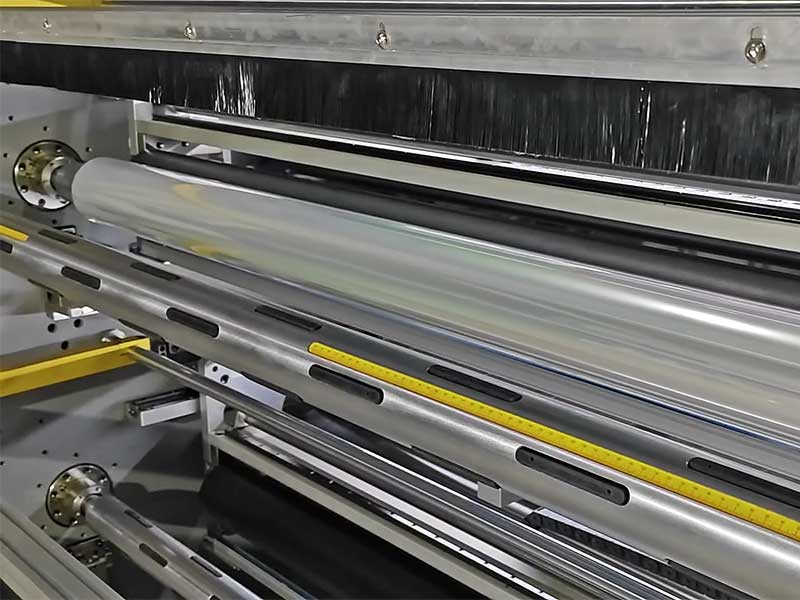
The surface of TPU paint protection film is far more delicate than PET Solar Film. Solar Film slitting machines' guide rollers are typically hard chrome plated, paired with static eliminators—already sufficient for Solar Film.
But TPU's tolerance for scratches is extremely low. The paint protection film slitting machine's film path requires full-path anti-adhesion treatment: guide rollers use hard chrome plating plus Teflon coating or ceramic coating, with friction coefficients pressed to extremely low levels to prevent TPU from being scratched due to slight adhesion during high-speed operation. Some models also use rubber-coated rollers or air-flotation guide rollers on key film-contact surfaces, further reducing the risk of hard contact.
Static electricity is also trickier in TPU slitting. Dust particles attracted after TPU friction charging, trapped between the film and guide rollers, become a continuous scratch. Configuring ion bars and dust removal rollers at the pre- and post-slitting nodes is standard practice on paint protection film slitting machines; while Solar Film machines also have static elimination, when facing TPU's higher surface tackiness and static adsorption tendency, the configuration level is often not on the same plane.
Can One Machine Handle Both?
Technically, "multi-purpose" configuration solutions exist, but you need to confirm whether the equipment supports parameter switching and tool changes. The real-world problem is: when you compromise TPU slitting parameters to accommodate Solar Film, the paint protection film yield directly reflects in scrap costs. The scrap cost of one roll of TPU paint protection film often equals the price of an entry-level slitting machine.
If TPU paint protection film is the main product, the hardware redundancy in tension lower limits, temperature control, and anti-scratch design on a dedicated paint protection film slitting machine cannot be compensated for by "adjusting parameters" on a Solar Film machine. If both are produced and volumes are significant, setting up separate production lines is more cost-effective than forcing one machine to serve both.
 English
 Deutsch
 Français
 Español
 Português
 日本語
 русский
 한국어
 عربي
 ภาษาไทย
 Tiếng Việt
 Italiano