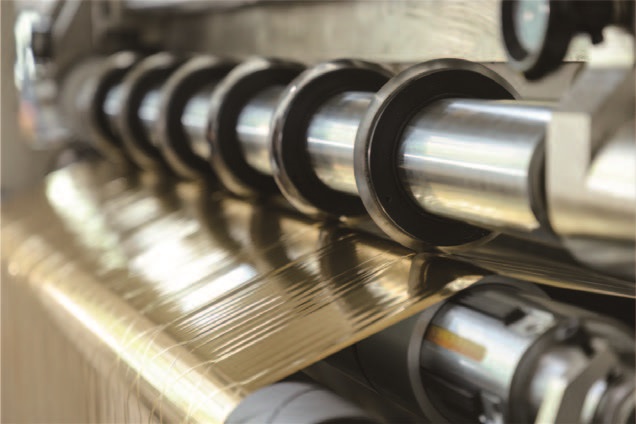
The slitting of TPU paint protection film essentially battles the material's "elastic memory." This highly elastic substrate undergoes irreversible plastic stretching when tension is slightly high, causing ruffles to appear at the finished edges, making it difficult to seal the edges properly during film application. The industry consensus is that the elongation rate of paint protection film slitting must be controlled below 0.2%, meaning the slitting machine must have stable output within a very tight tension range, rather than relying on the operator's feel to "find the critical point."
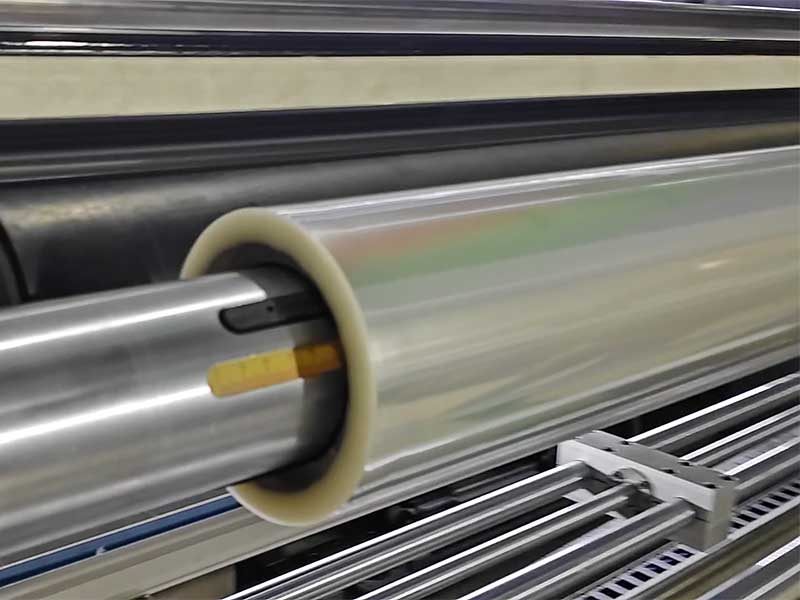
The core challenge of micro-tension control is that the tension requirements for TPU films differ in the unwinding, traction, and rewinding stages. The mother coil continuously changes from large to small, with torque demand; The winding ranges from fine to coarser. If constant tension is maintained, the inner film will become increasingly tight under pressure, eventually forming a flat-edge roll with loose inside and tight outside. Open-loop control relies on a preset fixed tension value, which cannot handle such dynamic changes. The truly effective solution is independent servo drives for unwinding, traction, and rewinding in stages, each section equipped with high-sensitivity tension sensors that monitor the actual tension of the film surface at millisecond-level frequencies, and then the servo motor adjusts torque in real time. Some high-end models even support a very low tension range of 0.1–5N, suppressing tension fluctuations to levels that negate the risk of stretching.
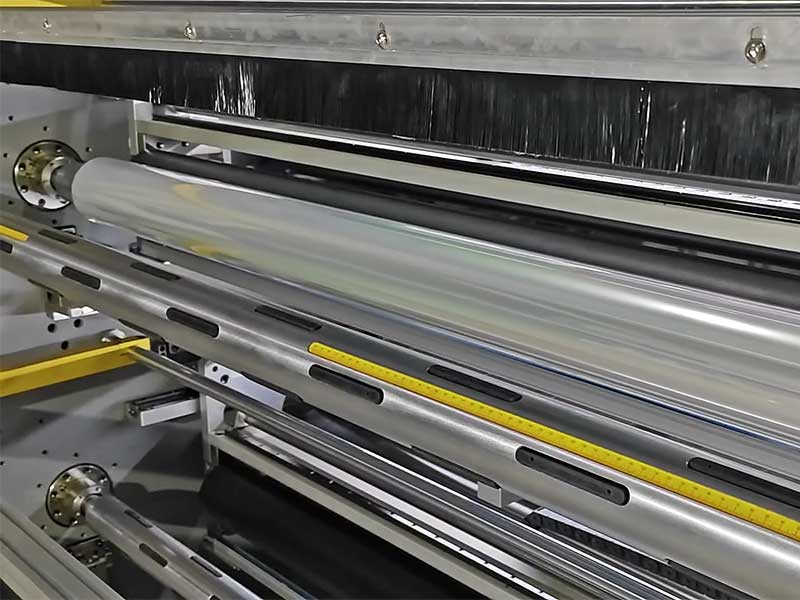
Microtension control during the winding stage also requires the addition of taper decreasing logic. As the coil diameter increases, the tension must be automatically and gradually reduced according to a preset curve to ensure consistent tension from the core to the outer layer, eliminating the "revealing" and "telescope" phenomena. Another easily overlooked detail is the tension buildup speed during the initial unwinding stage: if the tension rises too sharply during the master roll loading, the outermost film layers often fail immediately, and losses occur before the operator even begins formal slitting.
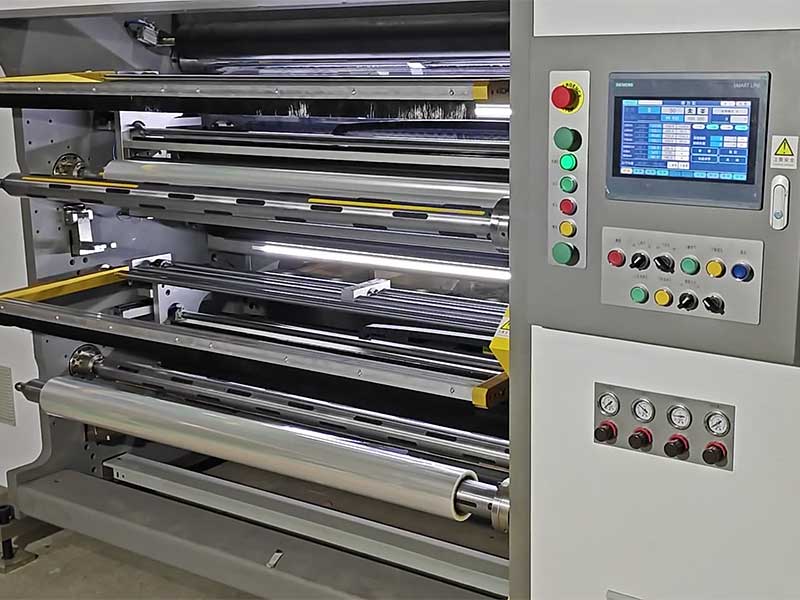
In addition to the tension algorithm itself, the mechanical structure also works with micro-tension targets. The low-inertia floating roller absorbs instantaneous tension disturbances, preventing relative slippage between the film surface and the guide roller due to speed differences, thereby eliminating the risk of scratches. If the equipment lacks this buffering mechanism, no matter how fast the servo responds, inertial shocks on the membrane surface during acceleration and deceleration will still leave hidden risks.
For automotive coating film processors, the most direct way to judge whether a slitting machine's microtension control is reliable is to use their own TPU master roll for on-site prototyping to measure the residual elongation of the film before and after slitting. An elongation rate below 0.2% is a passing line, and only equipment that can consistently maintain a value below this is qualified to take on high-end invisible car wrap orders. After all, the scrap cost of a roll of TPU paint protection film is often comparable to the price of an entry-level slitting machine.
 English
 Deutsch
 Français
 Español
 Português
 日本語
 русский
 한국어
 عربي
 ภาษาไทย
 Tiếng Việt
 Italiano