Solar film slitting is a key process in the production process that determines the yield of finished products. A wide mother roll is cut longitudinally into several narrow rolls, and the film remains in a dynamic operating state throughout the process. The task of tension control is to keep the tensile force on the film within a 'just right' range in the three stages of unwinding, traction, and rewinding. Excessive tension thins the membrane and tears the edges; If the tension is too low, the curl becomes loose, and the movement becomes deviated and wrinkled. Solar film itself is a multilayer composite structure, with different functional layers varying elastic modulus and elongation, making them much more sensitive to tension fluctuations than ordinary packaging films. Understanding the principle of tension control essentially means figuring out how to coexist with the "sensitive" nature of materials during high-speed operation.
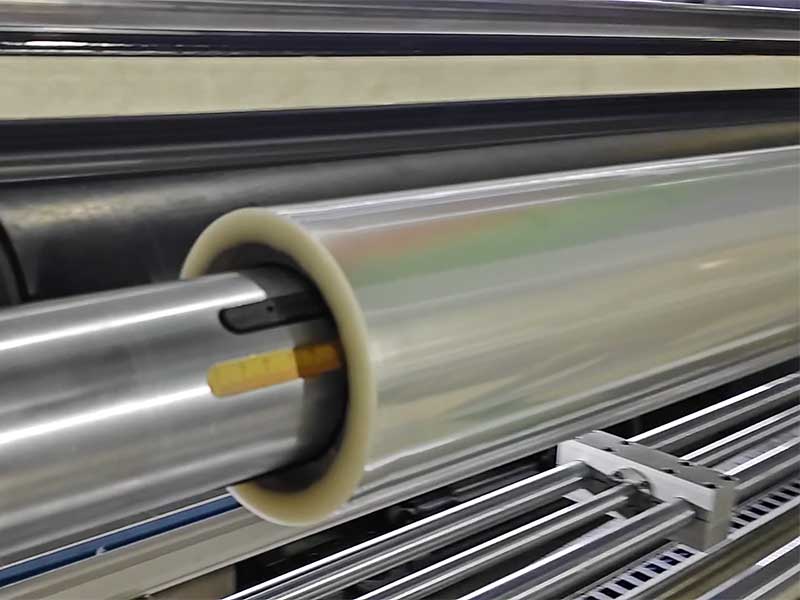
1. The Price of Losing Control of Tension: Why Is Sun Film Especially 'Delicate'?
The typical structure of a solar film includes a UV-blocking layer, heat insulation layer, explosion-proof layer, and mounting adhesive layer, but the thermoplasticity and mechanical response of each layer material are not consistent. When slitting tension fluctuates, the first issue to be exposed is dimensional accuracy: when the tension is too high, the film is stretched slightly during movement, and after winding, stress is gradually released, resulting in the actual width of the finished product being less than the set value; When tension is low, the film surface is loose, and the lateral correction system operates frequently, resulting in uneven end faces.
More hidden damage occurs at the microscopic level. The surface of solar membranes often has nanoscale coatings or functional microstructures; excessive tension can disrupt these precise arrangements and affect optical performance; Uneven stress between layers may lead to delamination of the composite structure. Additionally, if the tension remains constant during winding, as the roll diameter increases, the outer film continuously accumulates compression on the inner layer, and the radial pressure on the inner film may exceed its yield strength, resulting in "ruffle edge" or "telescope" type end face defects. These defects may not be visible to the naked eye during slitting, but can be exposed as bubbles, edge-lifting, or creases during subsequent film application.
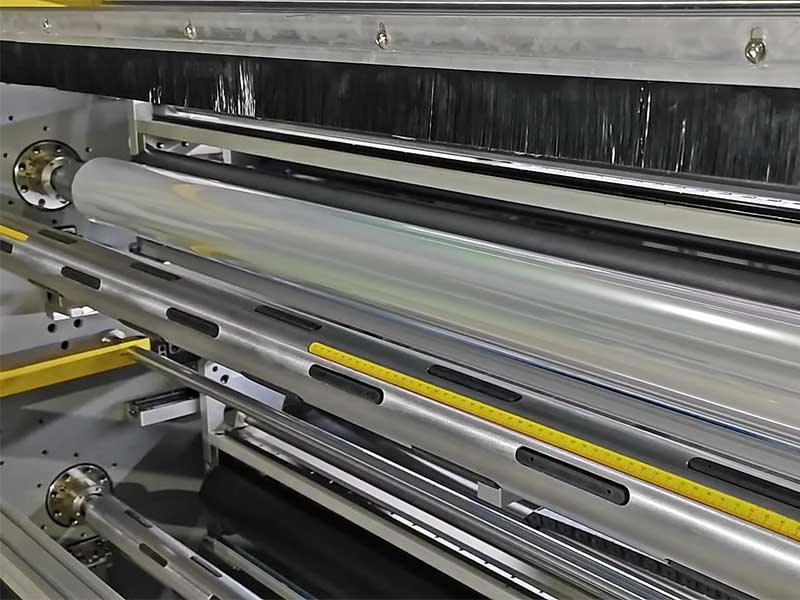
2. The basic loop of closed-loop control: millisecond-level response from detection to execution
The tension control system of modern solar membrane slitting machines is a typical closed-loop feedback architecture, consisting of three stages: detection, calculation, and execution, with cycle times measured in milliseconds.
The core of the inspection process is the tension sensor. Common forms include tension detection rollers (load cells) and floating roller displacement sensors. The tension rollers are connected in series along the film path. When the film passes around the roller surface, the pressure applied to it is converted by sensors into electrical signals, reflecting the tension level in that section in real time. The floating roller senses changes in tension through physical displacement: when tension increases, the rolling roller is pulled to one side; When the tension decreases, the cylinder or spring pushes it back. Displacement is converted into electrical signals by potentiometers or encoders, indirectly representing tension. Some high-end equipment also adds encoders at the rewinding shaft end to assist in adjusting tension models by calculating changes in the roll diameter.
The computing phase is handled by a PLC or a dedicated controller. After the sensor signal enters the controller, it is compared with the preset target tension value, and the resulting deviation is fed into the control algorithm. The most commonly used in industrial settings is PID control—proportional terms respond to current deviations, integral terms eliminate steady-state errors, and differential terms suppress overshoot. However, the special feature of solar film slitting is that as the winding diameter continues to increase, the system's moment of inertia and dynamic characteristics change accordingly, making it difficult for fixed-parameter PID to maintain optimal performance within the full roll diameter. Therefore, in practical systems, segmented PID or adaptive PID are often used, switching control parameters according to the roll diameter range. More advanced solutions introduce fuzzy logic, allowing the controller to adjust output force based on the magnitude and rate of change of tension, reducing the burden of manual parameter setting.
The execution stage is distributed across three sections, each undertaking different control tasks. The unwinding zone is usually supplied by magnetic powder brakes or servo motors to provide resistance torque, which maintains stable tension by adjusting the braking torque. Since the coil diameter decreases from large to small, the same braking torque generates less tension when the diameter is larger, and higher when the diameter is smaller. Therefore, the winding control must be linked with diameter detection to dynamically adjust the torque set value. The traction zone is located before the slitting blade, and the speed of the traction roller determines the linear speed of the film. Its tension control depends more on coordinating the speed difference between the front and rear sections. The winding area is the center of gravity for tension control. The servo motor drives the winding shaft, and the controller adjusts the motor output torque based on tension feedback. As the coil diameter increases, the torque required to maintain constant tension increases synchronously. However, as mentioned earlier, constant tension winding is precisely the cause of end face defects, so the winding area generally adopts a taper tension strategy.
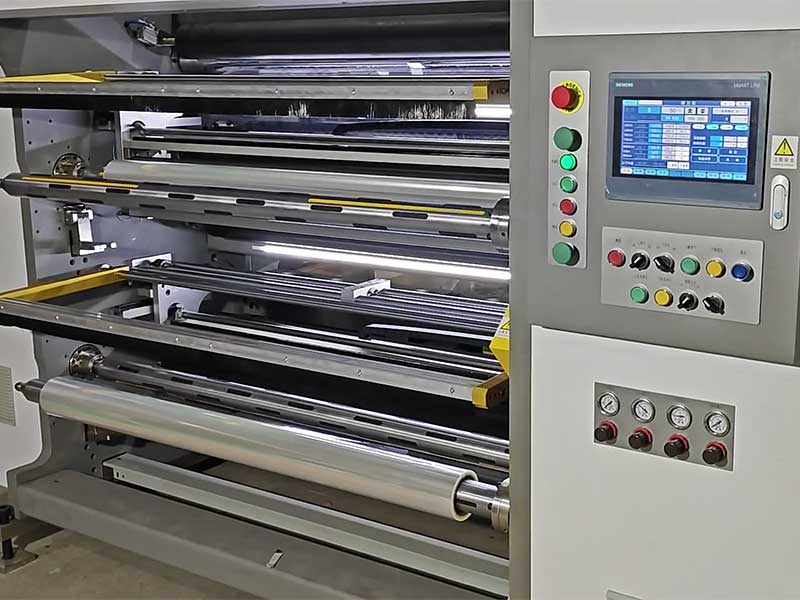
3. Taper tension: The core algorithm of the winding stage
Taper tension control is a key design that distinguishes solar film slitting from other processes. The basic idea is: the winding tension is no longer a fixed value, but gradually decays along a predetermined curve as the coil diameter increases.
Why is decay necessary? Imagine a film roll that gradually increases, with the outer film applying radial pressure to the inner layer during winding. If the winding tension is constant, this pressure increases linearly with the number of layers, and the film near the core is compressed tighter and tighter. When the pressure exceeds the material's elastic limit, the inner layer develops irreversible deformation or wrinkles. Taper tension makes the outer layer relatively "looser," suppressing the increase in radial pressure, and the tightness between the core and the outer layer tends to be more uniform.
The shape of the taper curve is determined by both material properties and process requirements. Common types include linear taper, piecewise taper, and exponential taper. Linear taper is the simplest, with tension decreasing from the initial value at a fixed slope with the rolling diameter. Segmented taper uses different attenuation rates across different diameter ranges. For example, the small diameter stage attenuates more slowly to keep the winding tight, while the large diameter stage accelerates attenuation to prevent inner layer overpressure. One implementation disclosed in the patent documents is: when the real-time diameter of the winding spindle reaches 1.5 times the initial diameter, taper tension adjustment is initiated, and the discrete PID controller converts the tension deviation into compensation for the winding motor torque, so that the actual tension tracking taper model provides the "optimal tension value." This phased intervention strategy ensures stable winding during small rolls while avoiding inner layer damage during large rolls.
4. Material Adaptation and Trends: From "Cutable" to "Cut Well"
The diversity of the solar film product line brings additional challenges to tension control. The surface friction coefficient and elastic modulus of dyed film, metal film, and ceramic film differ significantly, and the same set of tension parameters often needs to be re-tuned after material replacement. The current technical direction is to build a built-in material parameter library into the controller, pre-storing recommended tension values, taper curves, acceleration/deceleration slopes, etc., for commonly used film types as formulas, which can be accessed with one click during production changeovers, reducing reliance on operational experience.
Another noteworthy trend is the introduction of feedforward control. The essence of closed-loop feedback is "correction when a deviation occurs," while feedforward control attempts to compensate before a deviation occurs. For example, when the system detects that the slitting speed is about to increase, the film's inertial resistance will increase tension at the moment of acceleration, and the feedforward stage lowers the unwinding brake torque or increases the winding motor torque in advance, partially offsetting the tension disturbance caused by speed changes. Combined with digital twin technology, the slitting process can be rehearsed in a virtual environment, with tension parameters optimized before startup, further reducing trial-and-error costs.
Ultimately, the tension control of the solar film slitting machine is about balancing a problem of balance: the film must be "pulled tight" to ensure stable feeding and neat winding, but not "pulled too tight" to avoid damaging its multilayer composite structure. Sensors, algorithms, and actuators work together to find the force value every millisecond that makes the material both compliant and undamaged. Understanding this mechanism also explains why the slitting process is called the "ultimate gatekeeper" of solar film quality—it does not change the film's formula but determines whether the film's performance can fully reach the end.
 English
 Deutsch
 Français
 Español
 Português
 日本語
 русский
 한국어
 عربي
 ภาษาไทย
 Tiếng Việt
 Italiano

 Solar Film Slitter