When purchasing a single-sided tape slitting machine, many beginners often fall into two extremes: either they only look at the price, thinking "as long as it can rotate, that's fine"; Or blindly pursuing high specs, only to find the equipment "not adapting" when purchased. In fact, the core logic for selecting a slitting machine is not complicated—it's not that more expensive is better, but that the more "matched" the better.
So, which parameters truly determine whether a slitting machine can meet your production needs—these are the "hard indicators"? Below is a systematic overview from four dimensions.
1. Precision and Slitting Quality: The "Life-and-Death Line" of the Finished Product
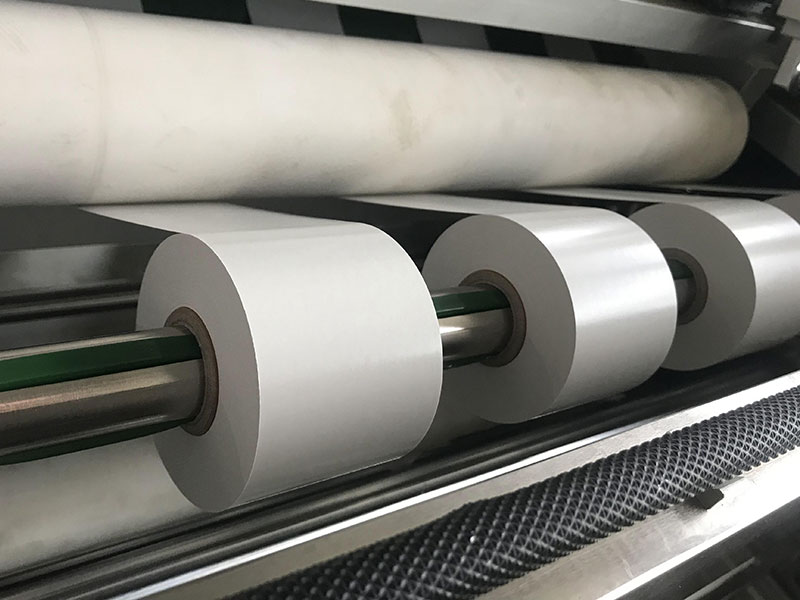
Slitting accuracy is the primary indicator for evaluating the performance of a slitting machine and directly determines whether the finished tape meets the customer's specifications. Accuracy typically includes two dimensions: width tolerance and end face flatness.
Width tolerance refers to the deviation between the actual width of the finished tape and the set width. Standard BOPP carton sealing tape can meet requirements with a precision ± 0.1mm to ±0.2mm; However, tapes used in electronic insulation, medical fields, and other fields often require ± 0.05mm or even higher. End face flatness is checked to check whether the edges of the slitted tape roll are smooth, free of burrs, and free of "string rolling" issues.
The core factor affecting accuracy lies in the tool system. Round cutters (upper and lower cutter shear type) offer high precision, neat cuts, and long blade lifespan, making them the mainstream choice for high-precision solutions today; Flat blades are low-cost, suitable for thicker tapes or those with lower end-face requirements, but precision decreases rapidly after long-term use; Air knives are suitable for ultra-thin materials but have higher investment and maintenance costs.
Buying advice: Do not trust the "theoretical accuracy" in brochures. The most reliable method is to bring your most "hardest" material — the thinnest, softest, and stickiest kind — to the manufacturer on-site for a trial cut, use a caliper to measure the width deviation of the finished product, and personally observe the end face effect.
2. Matching Speed and Capacity: Don't Pay for Performance You Don't Need to Use
Slitting speed directly affects daily output, but there is a common misconception: the "maximum speed" labeled by manufacturers is often the extreme value under ideal conditions; the actual stable operating speed is what truly matters.
On the market, economical slitting machines operate at speeds of about 100–150 m/min, medium-high-speed models at 200–300 m/min, and high-end models can exceed 400 m/min. The higher the speed, the greater the demand for tension control, winding uniformity, and correction systems. Blindly chasing high speeds may lead to frequent shutdowns for debugging and a large amount of scrap.
For beginners or small-batch production scenarios, adjustable speed models from 0–120 m/min are actually a more practical choice—easy to get started with and quality controllable. Experienced medium-batch producers can consider 150–200 m/min, while high-speed machines above 300 m/min are needed for large-scale professional production. It is recommended to estimate the required speed backward based on daily output, leaving a 20%–30% margin, and focus on the precision performance of the equipment at "economic speed."
3. Material Compatibility and Tension Control: The Easily Overlooked "Hidden Threshold"
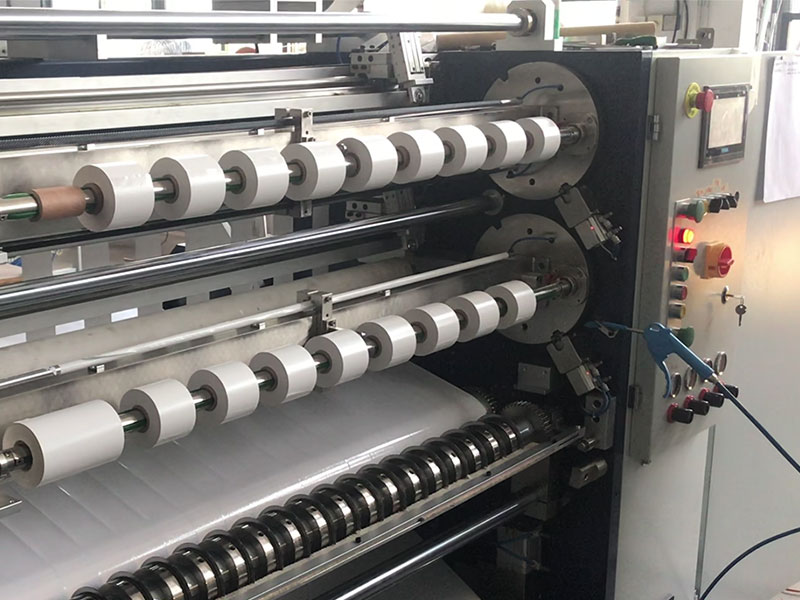
There are many types of single-sided adhesive substrates, and different materials have vastly different requirements for equipment. BOPP carton sealing tape requires high speed but moderate precision; The base material of masking paper/washi tape breaks easily and requires extremely stable tension control; Protective film materials are extremely thin and prone to static electricity and bubbles, requiring anti-static devices and low-viscosity winding functions; Special industrial tapes (such as polyimide) have high value and narrow widths, requiring extremely high flatness on the end face.
Behind these differences, tension control systems are the core technical link that determines the success or failure of slitting. Single-sided tape is an elastic material; unstable tension can cause the tape to stretch and deform, uneven in tightness (such as "cauliflower rolls"), misalignment, or even material breakage. Currently, there are two mainstream tension control solutions: magnetic particle clutches (open-loop control), which are economical but tend to heat up easily, suitable for ordinary BOPP tape; Servo motors combined with closed-loop control offer higher precision (tension fluctuations can be controlled within ±1%, and for tensile-sensitive materials such as thin PET film and masking paper, closed-loop servo control is almost a must-have.
Buying advice: First, list all the types of tape you need to slit, and use the thinnest, narrowest, stickiest, or most deformable type as the benchmark for equipment performance.
4. Winding Capability and Core Compatibility: The "Hidden Parameters" Affecting Downstream Processes
This parameter is often overlooked, but it directly determines whether the finished roll can be adapted to the customer's equipment. The larger the maximum winding diameter (e.g., φ300mm, φ400mm), the longer the single roll length and the fewer changes required; However, increasing the diameter raises the internal tension gradient, which can easily cause belt deformation or uneven end faces, so a comprehensive assessment should be made based on the material.
The compatibility of the core inner diameter is equally crucial. Common specifications include 3-inch, 6-inch, or 1-inch plastic cores. High-end slitting machines use shaftless clamping or air expansion shaft designs, allowing core replacement in just a few minutes; Low-end machines may require manual switch replacement, which is time-consuming and reduces accuracy. If your customers require multiple core specifications, prioritize models with quick core change devices.
Moreover, the level of automation is becoming an important dimension for distinguishing equipment grades. Manual tool layout changes require 10–30 minutes of machine downtime, while automatic tool layout systems input specifications via touchscreen, and the tool holder automatically moves into position, reducing specification change time to under 1 minute. In scenarios with many order batches and frequent specification changes, this efficiency difference quickly accumulates into considerable labor costs.
Practical Selection: Three Steps to Lock in the Right Equipment
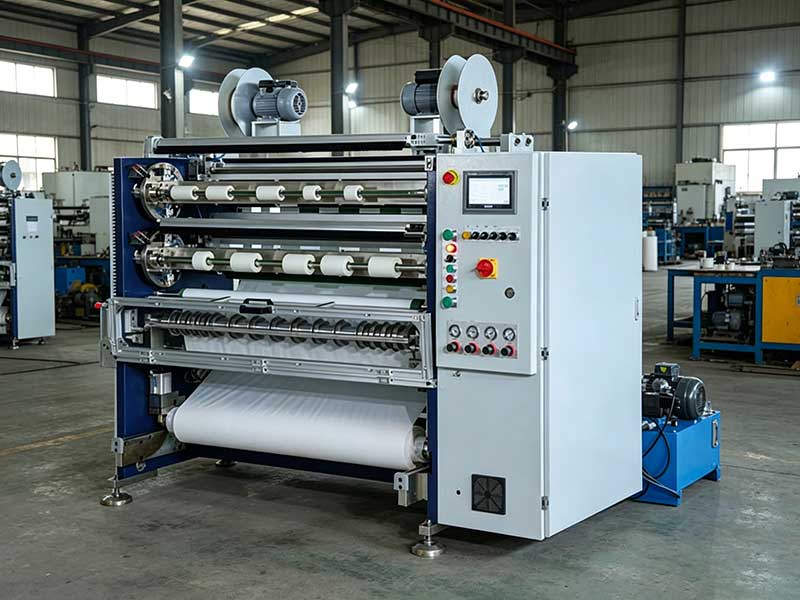
Based on the above parameters, the selection can be summarized into three steps:
Step one: clarify your own needs. List the maximum width of the main roll you use daily, the narrowest slitting width, typical tape material, average daily output, and batch specifications. This data forms the basis for all subsequent decisions.
Step two: On-site machine testing with the "most difficult" materials. This is the gold standard for verifying the true performance of equipment, far more reliable than just reading the parameter table. Focus on observing end face neatness, measured width tolerances, and have the manufacturer demonstrate the entire process of tool replacement and adjustment.
Step three: calculate total cost, not just the bare phone price. A slitting machine with poor precision may waste tape material worth a year far more than the price difference of the machine. It is necessary to comprehensively compare equipment prices, annual fees for consumables such as blades and rubber rollers, energy consumption, and maintenance costs.
Ultimately, choosing a single-sided rubber slitting machine is about finding the most suitable balance between precision, efficiency, and stability. There's no need to blindly believe in the fastest speed or the biggest brands; a "matched" device is the one that can truly generate continuous profits for you.
 English
 Deutsch
 Français
 Español
 Português
 日本語
日本語 русский
 한국어
한국어 عربي
عربي ภาษาไทย
 Tiếng Việt
 Italiano
 Film Slitting Machine
 Ribbon Slitting Machine
 Slitter Rewinder Machine
 Tape Slitter
 High Speed Slitting Machine
 Barcode Ribbon Slitting Machine
 Single Side Adhesive Slitter
 Label Slitter