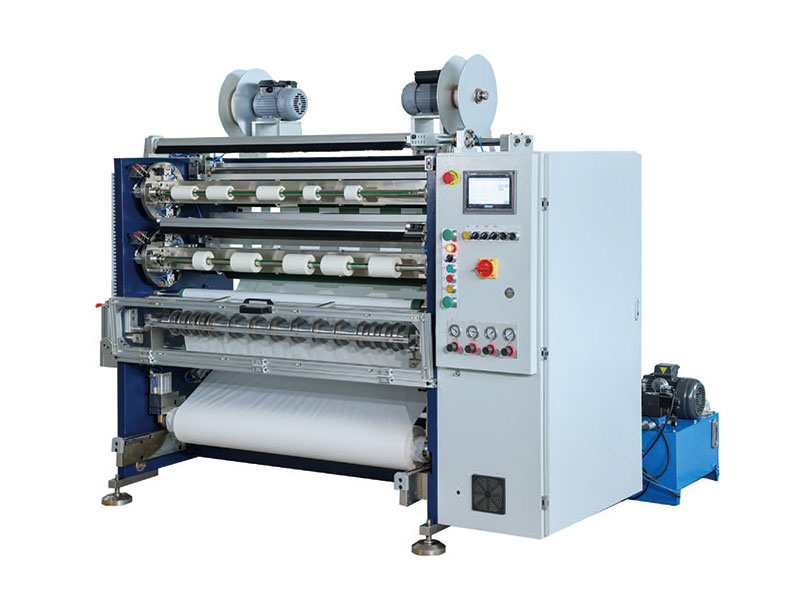
From the sealing adhesive used for daily express packaging, to the precision protective film inside mobile phone screens, and even the high-temperature resistant electrical adhesive on automotive wiring harnesses—these ubiquitous single-sided rubber products all rely on a key piece of equipment in their production: the single-sided adhesive slitting machine. Simply put, it is a specialized machine that precisely "breaks down wide-width adhesive rolls" into small finished rolls of narrow specifications to meet our requirements.
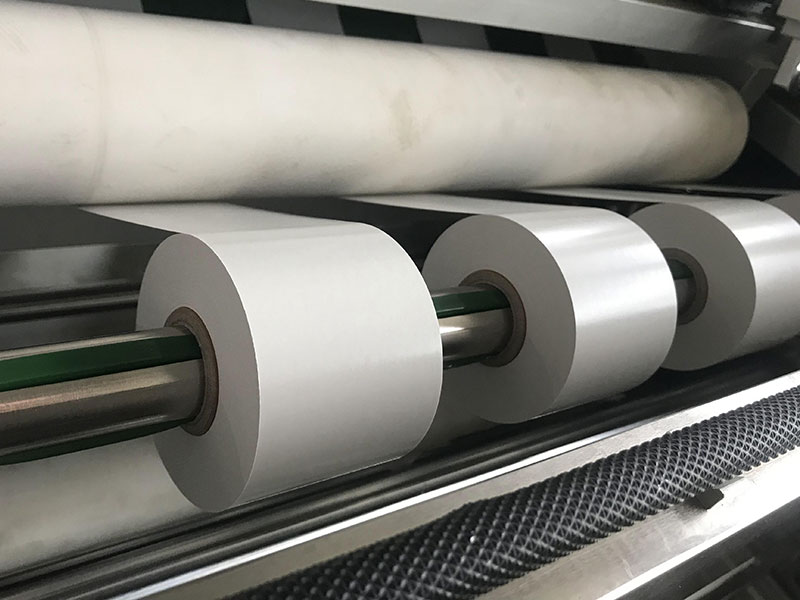
From "Big Roll" to "Small Roll": How to Understand How It Works?
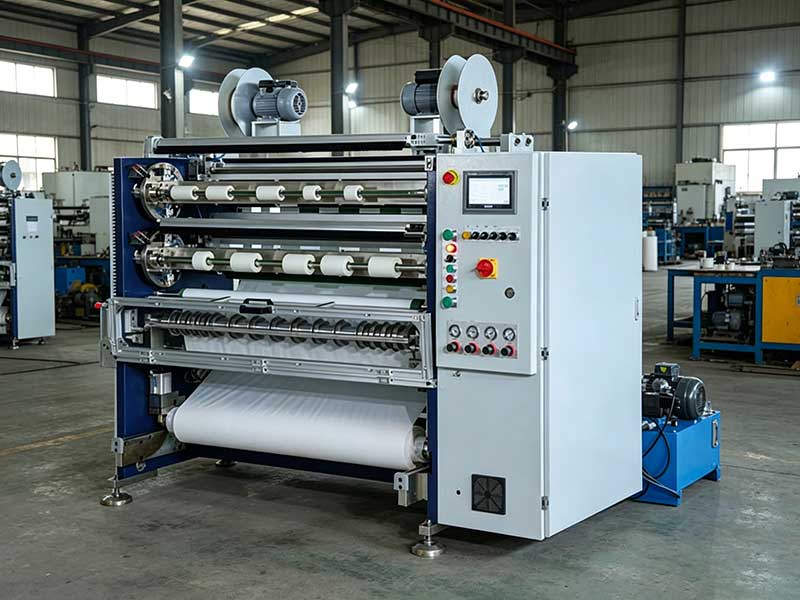
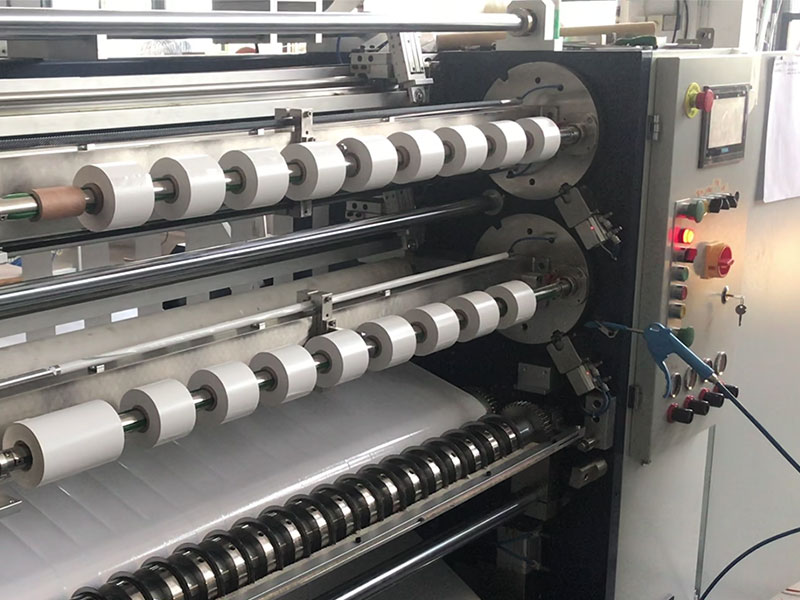
The workflow of the single-sided adhesive slitting machine can be seen as a highly automated production line. Its core task is to precisely cut the entire roll of raw material and simultaneously roll it into several neat small rolls. The entire process revolves around four core components:
1. Unwinding (feeding): Install the wide-width adhesive roll weighing several hundred kilograms onto the unwinding shaft of the slitting machine and securely fix it using a tension control system.
2. Film penetration and smoothing: One end of the adhesive is pulled out and passed through a series of guide rollers. These guide rollers not only guide the material forward, but more importantly, they eliminate wrinkles in the material itself through the leveling rollers, ensuring a smooth and flawless entry into the cutting area.
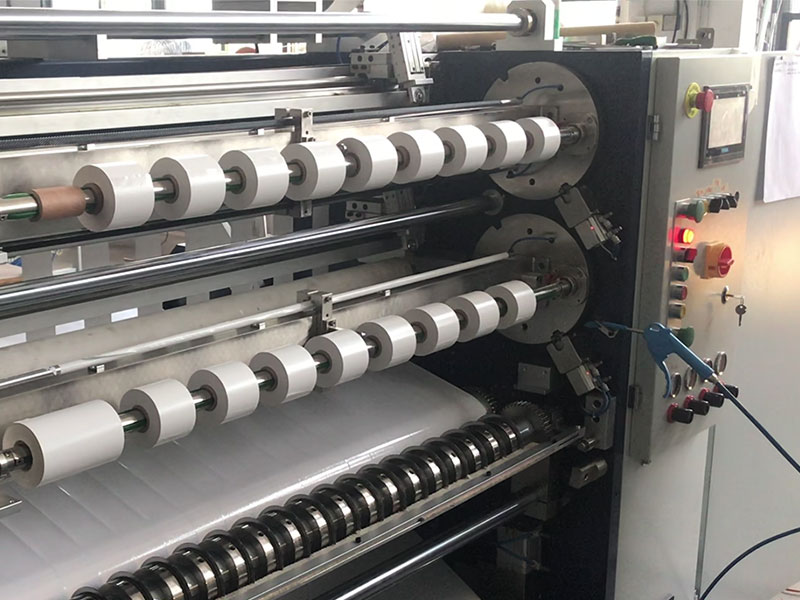
3. Slitting (core step): This is the core technology of the slitting machine. The material is cut longitudinally into preset narrow strips through a high-speed rotating circular or air blade system. Modern high-precision equipment uses closed-loop tension control, adjusting tension in real time at millisecond-level speed through sensors, ensuring that ultra-thin substrates (such as PET films < 0.01mm thick) do not break or wrinkle due to uneven tension. At the same time, the high-rigidity precision tool holder ensures precise seam positioning when multiple belts are slitting simultaneously, with width errors controlled within ±0.05mm.
4. Winding: After cutting, multiple narrow strips of adhesive are each rolled into neat finished rolls by their respective reels. Each winding spindle is usually driven by an independent servo motor, maintaining synchronized speed to prevent the finished product from being "loose inside, tight outside" or face misalignment.
Throughout the entire production line, the ultrasonic/photoelectric correction system continuously monitors the edge position of the adhesive to prevent it from deviating and ensuring a consistent cutting trajectory.
Technological Evolution: What Industry Pain Points Has It Addressed?
Early or low-end slitting machines often struggle when handling thin, high-tack adhesives. Modern single-sided adhesive slitting machines have systematically overcome the following challenges through technological upgrades:
• Breakage and wrinkling prevention: In the past, thin PET protective films were very prone to tearing during slitting. Today, a constant tension control system composed of servo motors and tension sensors can automatically adjust torque like "autonomous driving," avoiding tension spikes during start and sudden stops. Paired with ceramic coated guide rollers with an extremely low friction coefficient, it achieves protective processing of fragile substrates.
• Anti-blade adhesion: When cutting high-viscosity adhesive, the blade edge is often stuck by glue, causing instant tearing of the material. Modern equipment uses cemented carbide tools with release coatings, optimizes blade angles, and even adds high-frequency micro-vibration devices to effectively separate the rubber layer from the blade surface.
• Static elimination: adhesive running at high speed easily generates static electricity, attracting dust or winding rollers. The equipment is equipped with pulse-type AC ion bars at key stations to neutralize static electricity in real time, ensuring smooth production.
Which industries cannot do without it?
The single-sided glue slitting machine has a very wide range of applications, covering almost all fields requiring adhesive products:
| Application areas | Typical product examples | Core requirements |
| Packaging industry | Carton sealing adhesive, printing warning adhesive | High-speed, large-scale production, standardized dimensions |
| Electronics manufacturing | Phone screen protectors, battery securing adhesive, high-temperature resistant gold finger adhesive | Extremely high precision (micron level), burr-free edges, and does not damage thin substrates |
| Automotive industry | Wiring harness wrapping adhesive, interior fixing strips, soundproofing materials | It has strong weather resistance, good width consistency, and meets the requirements of automated assembly |
| Medical industry | Medical breathable adhesive and dressing films | The materials are special (such as non-woven fabric), and the slitting process must be clean and pollution-free |
Take the electronics industry as an example: if the ultra-thin conductive adhesive used to slit the inside of a phone lacks precision, resulting in burrs or width deviations at the edges, it may affect the fit and insulation performance of the phone's internal components. A high-precision single-sided glue slitting machine is the first line of defense to ensure the quality of these precision components.
 English
 Deutsch
 Français
 Español
 Português
 日本語
日本語 русский
 한국어
한국어 عربي
عربي ภาษาไทย
 Tiếng Việt
 Italiano
 Single Side Adhesive Slitter