Improving the slitting efficiency of self-adhesive label slitting machines is a key step for label processing enterprises to reduce unit costs and shorten delivery cycles. However, many factories fall into the trap of pursuing efficiency: equating the nominal maximum speed of equipment with actual output. In fact, a slitting machine rated at 200 m/min often achieves an effective speed of only 60 to 70% of the nominal value when slitting narrow-width film materials. True efficiency improvement requires advancing the system from four dimensions: balancing speed and precision, stability of tension control, deepening automation, and refined tool management.
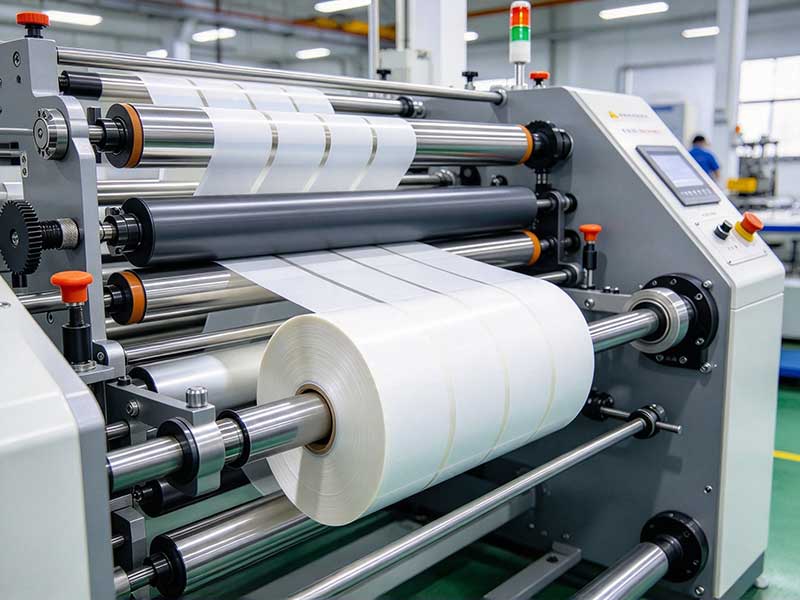
1. Speed and Precision: The Premise of Efficiency Is "Getting It Right the First Time"
The number one killer of slitting efficiency isn't the slow machine running, but the fast cutting produces scrap. Speed amplifies the flaw in accuracy: the shorter the material's residence time in the slitting zone, the narrower the window for tension fluctuations and correction response. A device that can barely operate at low speeds often encounters concentrated problems such as uneven end faces, paper cut-through, and glue overflow when reaching speeds above 150 m/min. The downtime losses caused by rework and scrap far exceed the price difference of the equipment itself.
Therefore, the first step to improving efficiency is to establish accuracy benchmarks. For ordinary paper self-adhesives, ± accuracy from 0.1 mm to ±0.2 mm is sufficient to meet most orders, so speed can be prioritized at this time; For high value-added products such as film materials (PE, PP, PET), electronic labels, and pharmaceutical labels, precision should be controlled at the ±0.05 mm level, with servo drive systems given priority. The resulting precision stability results in a neat winding end, significantly reducing downtime in downstream die-cutting or printing processes—which is itself an underestimated source of efficiency.
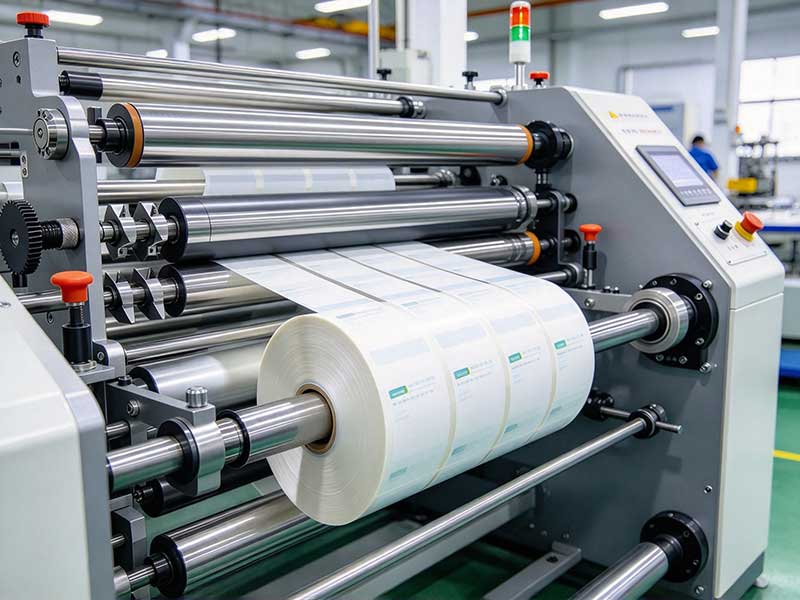
2. Tension Control: The "Invisible Frame" at High Speed
Self-adhesive is composed of three composite layers: the surface material, the adhesive layer, and the backing paper. If the tension of any one layer is uneven, the tape will show "serpentine" swinging, uneven end faces, or glue leakage after rewinding. The higher the speed, the greater the difference in inertia caused by the change in diameter from full to blank roll, making tension control exponentially more difficult.
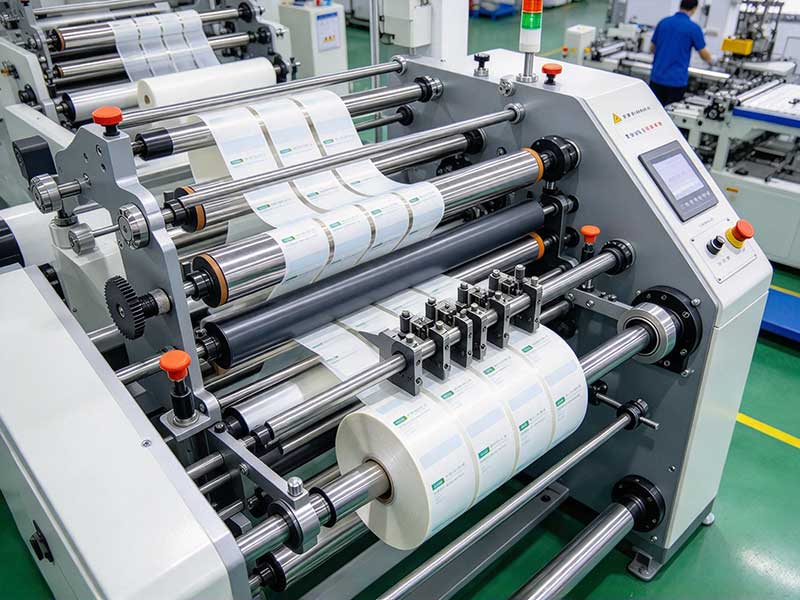
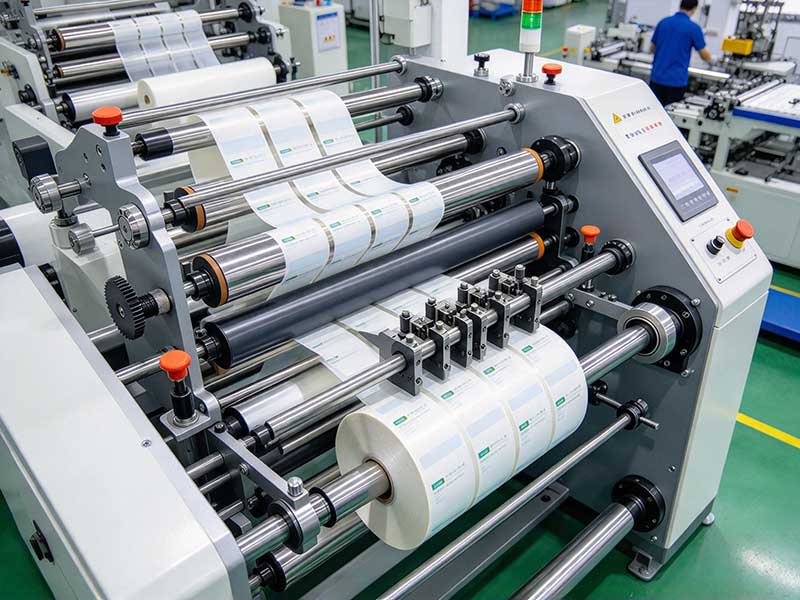
Efficient tension control requires closed-loop system support. The unwinding end provides real-time feedback from the tension sensor, and the PLC calculates the required braking torque based on changes in the roll diameter, keeping tension fluctuations within a narrow range; The winding end uses taper tension control to avoid collapse caused by "loose inside, tight outside." Some high-end models further realize independent servo control of three axes: unwinding, up-winding, and down-winding, allowing operators to set tension curves separately according to different material properties rather than relying on a single set of generic parameters to rigidly apply all orders. Only when tension is no longer a limiting factor can the equipment be able to operate stably and continuously at higher speeds.
3. Reduced downtime: Efficiency contributions from automation and quick-change design
The actual daily output of the slitting machine equals the operating speed multiplied by the effective operating time. Many factories have equipment rated at high speeds, but changing remolders, receiving and stopping machines, and waiting for unloading consume a large amount of capacity. Another key focus for improving efficiency is compressing non-cutting time.
During the order change process, the PLC system with parameter memory allows operators to retrieve saved process recipes on the touchscreen, without having to reset slitting width, tension values, or metering lengths item by item. The quick-change design of the winding shaft is also crucial: the ability to quickly swap between the expansion shaft and the slip shaft allows the same equipment to handle both large long roll orders and efficiently handle small batches of multiple specifications for short orders. In addition, basic automation functions such as automatic meter counting, fixed-length stops, and material shortage shutdowns, though seemingly simple, can save tens of minutes of ineffective running time per shift.
For the mass production of standardized labels, the value of integrated equipment is even more apparent. For example, some roll-to-roll label cutting and finishing machines use a dual-head design to support simultaneous processing, doubling throughput compared to single-head models. They integrate lamination, half-cutting, waste removal, and slitting into a continuous process, reducing material circulation and waiting between different equipment.
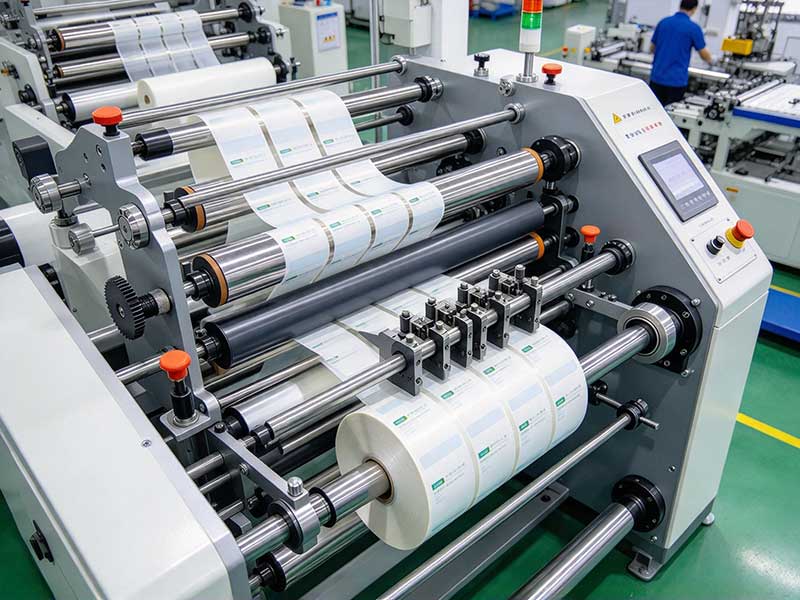
4. Tool Management: An Overlooked Efficiency Variable
The adhesive layer of the self-adhesive softens due to friction heat during high-speed slitting, making it easy to adhere to the blade and form material accumulation. Once adhesive builds up on the blade, slitting resistance increases, edge burrs increase, and operators have to stop the machine for cleaning. These seemingly trivial downtime accumulates significantly in high-speed slitting scenarios.
Measures to address this issue include: installing a high-pressure air gun or brush at the blade holder to automatically clean the blade surface according to the set meter; For hot melt adhesive materials, an air-cooling system can be used to control the blade temperature below the glue softening point; In tool selection, cemented carbide inserts perform significantly better in wear resistance and anti-stick material resistance under high-speed slitting conditions compared to traditional high-speed steel. Additionally, by establishing tool change cycles based on slitting meters or edge wear detection, the passive mode of "cutting until a problem occurs" can eliminate slowdowns and scrap caused by tool condition deterioration before they occur.
Conclusion
The efficiency improvement of self-adhesive label slitting machines is essentially a systematic project aimed at reducing ineffective time. Nominal speed is only the starting point; what truly determines output is the equipment's ability to operate continuously under stable precision, the tension system's responsiveness to changes in coil diameter, the smoothness of order change and discharge transitions, and the controllability of tool status. If you focus only on speed parameters and ignore these support conditions during selection, high speed may actually become an amplifier of scrap and downtime rates. For most label processing companies, a machine with solid precision, stable tension, and automation matching the order structure often delivers better actual output than a "high-speed machine" with attractive parameters but compromises at every turn.
 English
 Deutsch
 Français
 Español
 Português
 日本語
 русский
 한국어
 عربي
 ภาษาไทย
 Tiếng Việt
 Italiano

 Self-Adhesive Slitter Rewinder