The demand for short-run packaging, security labels, and premium finishes has pushed converters toward multi-material slitting. A single machine that can handle holographic security foil in the morning and cold foil for a packaging run in the afternoon is no longer a luxury—it is a competitive necessity. However, treating these three foil types as “just thin film” is the fastest route to edge burrs, tension wrinkles, and rejected rolls.
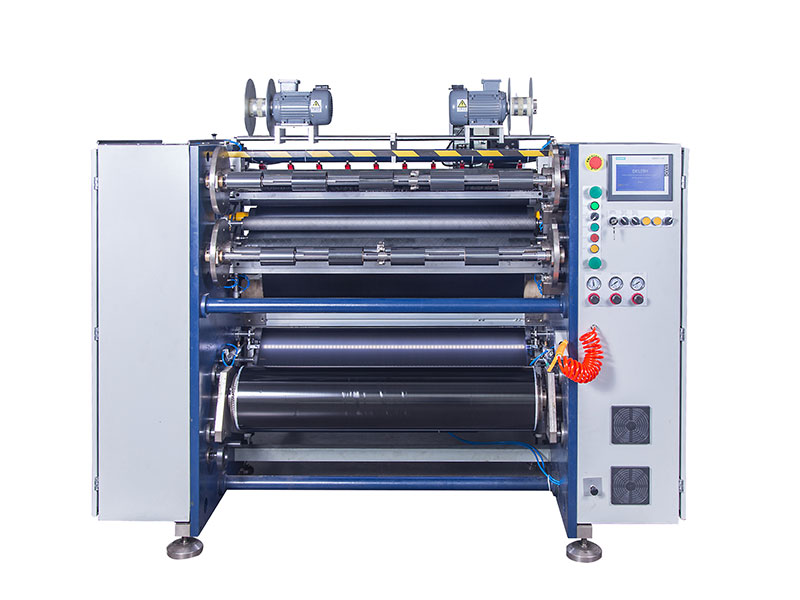
This guide breaks down the material-specific parameters for slitting holographic, cold, and hot stamping foils on a shared slitting platform.
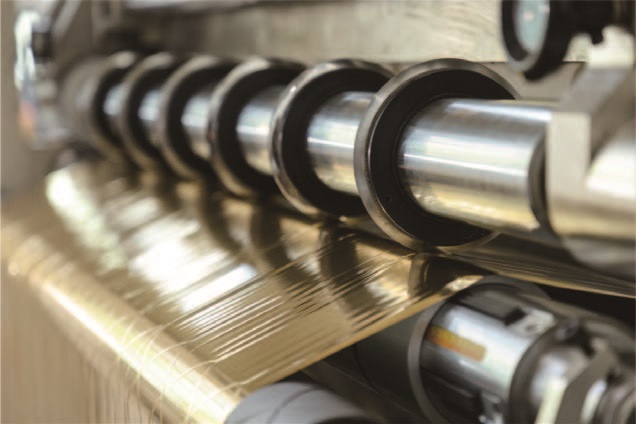
Understanding the Material Divide
Before adjusting a single dial, the operator must recognize that these foils differ not just in thickness, but in layer architecture and mechanical behavior.
Hot stamping foil is a multi-layer transfer film. A PET carrier provides dimensional stability, followed by a release layer, a color or metallized layer, and an adhesive size coat. The functional layers are fragile; the release layer is designed to fail precisely under heat and pressure, meaning any mechanical friction during slitting can pre-trigger delamination.
Cold foil is engineered for adhesive transfer in-line with printing presses. It is typically thinner and more sensitive to tension than hot stamping foil, as it lacks the same rigid carrier architecture and relies on a pressure-sensitive adhesive system that can be compromised by excessive nip pressure or heat buildup during slitting.
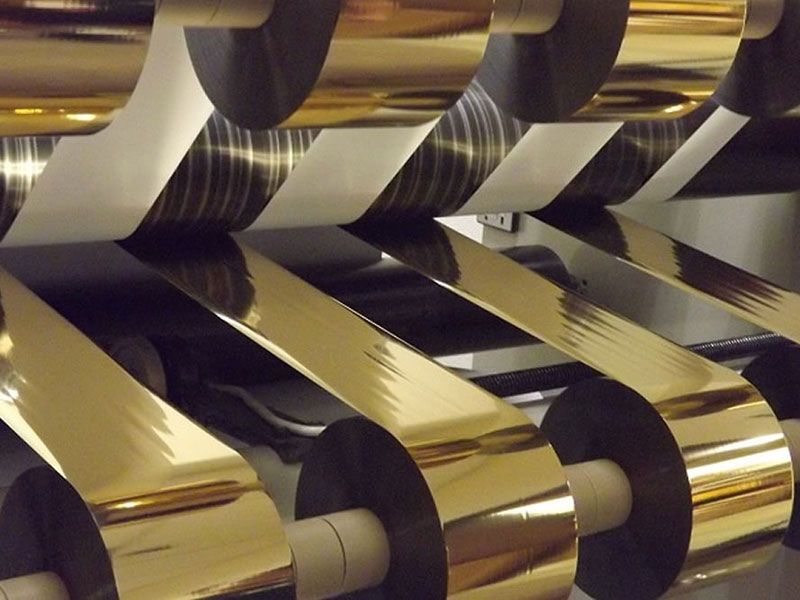
Holographic foil—whether hot or cold—adds a micro-embossed surface. The holographic image is a physical microstructure, not just a printed pattern. Any contact with a dirty guide roller, a burred slitting blade, or a vibrating web path can smear or scratch the diffraction grating, rendering the security feature visibly degraded.
Blade Geometry and Clearance: The First Variable
The single most consequential adjustment when switching between these materials is the shear clearance and overlap.
For hot stamping foil, the side clearance between circular knives should be set slightly larger than the foil thickness—typically in the range of 0.02 to 0.05 mm for thin grades. The overlap should be minimal, described by operators as “touching but not pressing.” If the clearance is too wide, the metallized layer is torn rather than cut, producing a burr that will obstruct transfer during stamping. If it is too tight, the brittle aluminum layer fractures under lateral compression.
Cold foil benefits from the same general clearance philosophy, but because it is often softer and more adhesive-sensitive, the blade edge must be sharper for longer. A dull blade on cold foil will generate friction heat that softens the adhesive, causing the slit edge to block or “weld” onto the adjacent layer during rewinding. Tungsten carbide or ceramic-coated blades are recommended for extended runs to maintain edge keenness.
Holographic foil demands the most conservative clearance of the three. The embossed layer is unforgiving of any compressive stress. The clearance should be set at the lower end of the acceptable range for the base film thickness. Equally important is blade axial runout. If the knife shaft runout exceeds 0.003 mm, the holographic surface will show periodic wave marks or sparkle loss even if the cut width is dimensionally correct. A dial indicator check on the knife shaft before every holographic run is not optional; it is the baseline.
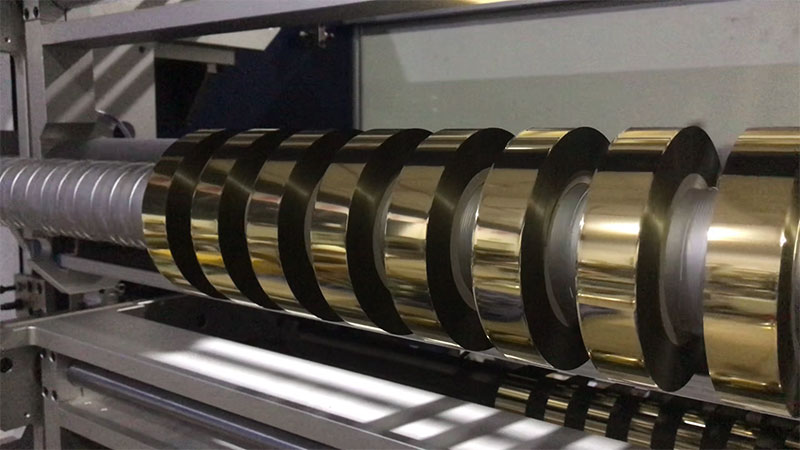
Tension: Where Foils Fail Differently
Tension is the silent variable. All three foils are thin and extensible, but their elastic responses differ enough that a “set and forget” tension profile will produce acceptable results for one material and catastrophic results for another.
Hot stamping foil can tolerate moderate tension because the PET carrier is relatively robust. A starting point for 12 μm electro-aluminum foil is often cited as 5–8 N unwind / 8–12 N rewind, with the critical requirement being fluctuation within ±0.5 N. The rewind tension must taper as the roll diameter grows; a taper of 15–25% is typical to prevent inner-layer compression wrinkles.
Cold foil requires lower tension than hot stamping foil of similar thickness. The adhesive layer is pressure-sensitive, and excessive rewind tension can cause the layers to cold-flow and block. Start with unwind tension at the lower end of the machine’s controllable range and increase only until web flatness is achieved. If the finished roll shows “tin canning” or edge curl, reduce taper rather than increasing base tension.
Holographic foil sits between the two in tension tolerance but is least tolerant of tension fluctuations. The embossed layer is stiff relative to the carrier, and rapid tension swings can cause micro-cracking along the slit edge that is invisible at the rewinder but appears as sparkle dropout after stamping. Closed-loop tension control with a load cell is strongly preferred over open-loop torque control for this material.
Rewind Shaft Selection and Slip Compensation
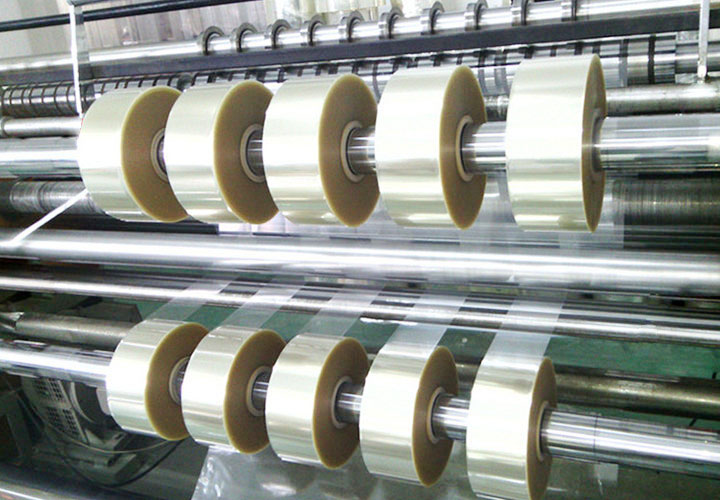
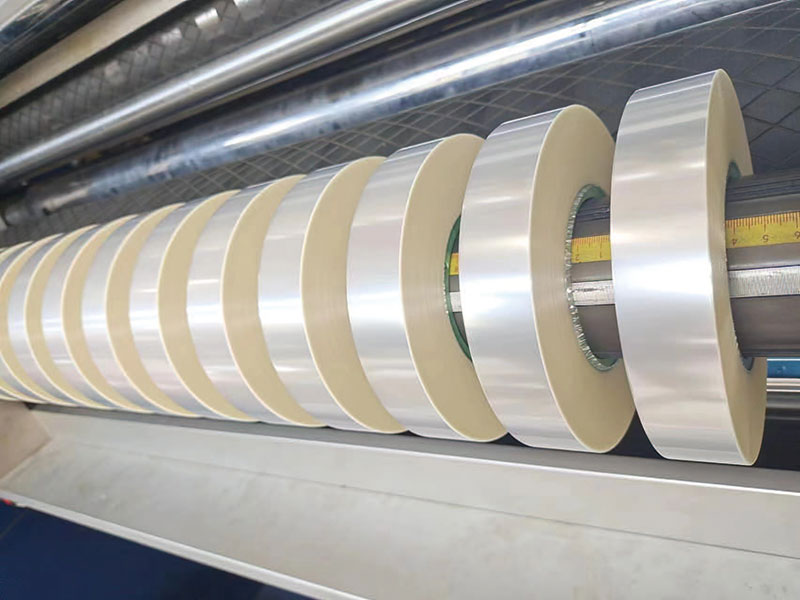
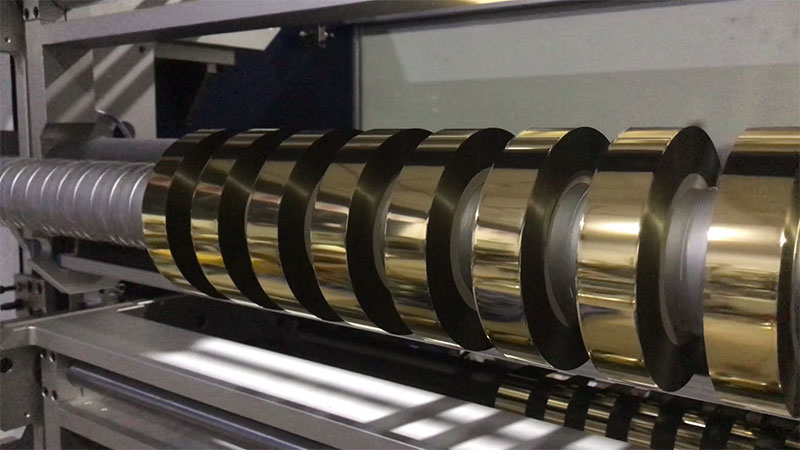
When slitting narrow widths—common for holographic stripes used in security threads—the rewind shaft choice directly affects roll quality. A slip friction air shaft (differential shaft) is recommended for multi-strip rewinding of all three foil types. The slip rings compensate for minute thickness variations across the web, allowing each narrow strip to wind at a consistent tension independent of its neighbors. Without differential slip, a thick spot in one strip will cause that roll to wind tighter, stealing tension from adjacent strips and producing uneven end faces.
For holographic security foil especially, individual pressure rollers per strip are beneficial. The embossed surface is sensitive to both pressure and vibration; a full-width press roller that bridges multiple strips will transfer tension variations from one lane to another. Individual rollers isolate each slit band, maintaining flatness without crushing the holographic microstructure.
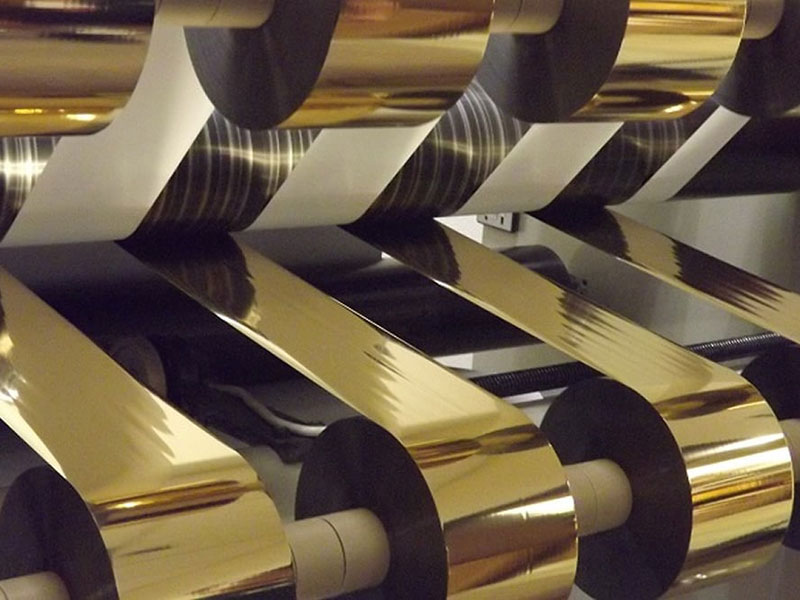
Static Control and Contamination
PET-based foils generate static aggressively, particularly at the slitting point where the web is separated. Charged foil attracts dust and airborne debris, which then embeds into the rewind roll and causes pinholes or transfer defects in the final stamping process. An ionizing bar immediately before the rewind nip is the minimum countermeasure. For holographic foil, the bar should be positioned so that it neutralizes the web after slitting but before the strips converge on the rewind shaft.
Roller cleanliness is equally critical. Any dried adhesive residue, dust, or metallic flake on a guide roller will transfer to the foil surface. For holographic foil, this contamination is not merely cosmetic—it can destroy the optical effect in a localized patch. Establish a roller inspection and cleaning routine between material changeovers, not just at shift start.
Practical Changeover Checklist
When moving a single machine from hot stamping foil to cold foil to holographic foil, the following sequence minimizes trial-and-error:
1. Verify knife shaft runout with a dial indicator. Do not proceed if radial deviation exceeds 0.003 mm for holographic or 0.005 mm for other foils.
2. Set shear clearance appropriate to the incoming material: 0.02–0.05 mm for hot stamping and cold foil; narrow end of that range for holographic.
3. Change or inspect blades. Cold foil and holographic foil should start with a fresh or freshly sharpened edge.
4. Select rewind shaft based on slit width. Use differential slip shafts for narrow multi-strip runs.
5. Program a tapered tension profile matched to the material. Start conservative and increase only if web flatness demands it.
6. Engage static elimination and confirm ion bar function.
7. Run a short trial and inspect the slit edge under magnification. Burrs on hot stamping foil indicate clearance too wide; sparkle loss on holographic foil indicates blade runout or excessive tension fluctuation.
Conclusion
A single slitting machine can process holographic, cold, and hot stamping foils successfully, but only if the operator treats the changeover as a material-specific setup rather than a width change. The differences that matter are measured in microns and newtons: shear clearance, blade runout, tension taper, and slip compensation. Get those right, and the machine becomes a flexible profit center. Ignore them, and every foil type will find its own way to fail.
 English
 Deutsch
 Français
 Español
 Português
 日本語
 русский
 한국어
 عربي
 ภาษาไทย
 Tiếng Việt
 Italiano

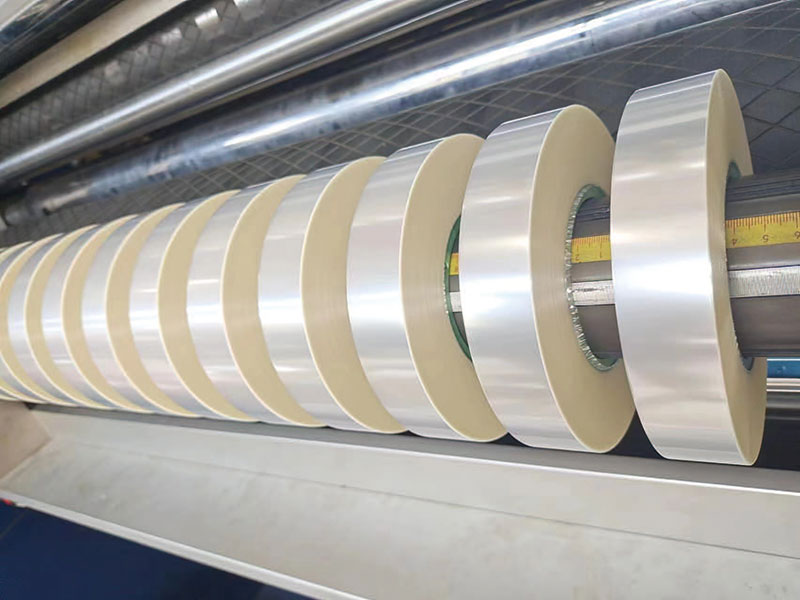
 Cold Foil Slitter
 Digital Enhancement Foil Slitter
 Silk Screen Printing Foil Slitter