In the tape manufacturing industry, single-sided tape has a wide range of applications, from daily packaging, electronic component fixation, to automotive wiring harness bandaging, medical dressing pasting, all of which are inseparable from it. As the core equipment for converting wide master coils into customized finished rolls, the slitting accuracy of the single-sided adhesive slitting machine directly determines the yield, performance and production efficiency of downstream customers.
Insufficient accuracy can lead to edge burrs, excessive width deviations, uneven winding, and even "swinging edges". So, how to systematically improve the slitting accuracy of single-sided adhesive slitting machine? The following three key technologies are key.
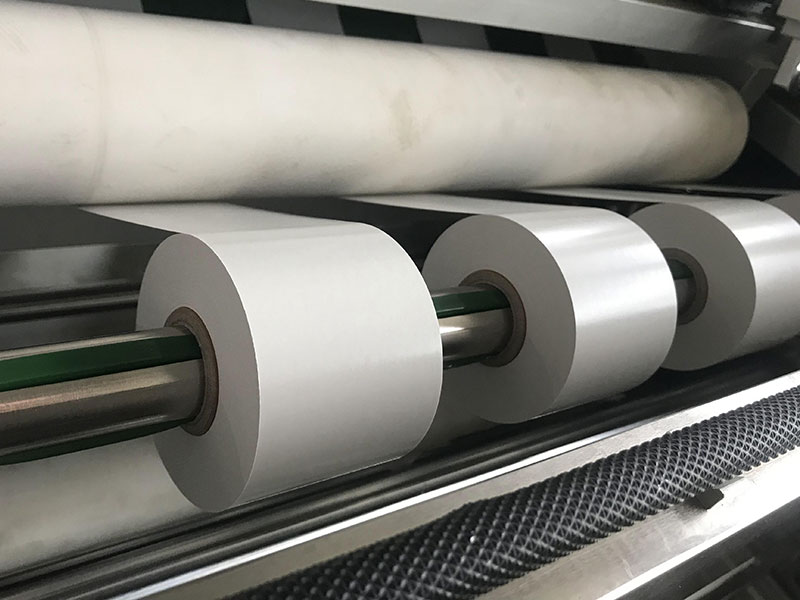
1. High rigidity precision tool holder and tool system
The tool system, the execution unit of the slitting action, is the primary link that determines the accuracy. After long-term high-speed operation of traditional slitting machines, the tool holder is prone to small vibrations or displacements, resulting in deflection.
1. Integral Casting Tool Holder Structure: Modern high-precision slitting machines use integral casting tool holders optimized by finite element analysis, which far exceed the steel plate welding structure in terms of rigidity and vibration resistance. Even in high-speed slitting above 300 m/min, the tool holder can maintain micron-level positioning stability, fundamentally eliminating blade shift caused by frame deformation.
2. Pneumatic/servo flexible pressing and shearing combination: For single-sided adhesives (especially OPP and PVC tapes with thin belts), simple upper and lower circular knives are easy to cause extrusion deformation due to rigid cutting. The advanced technology adopts the lower knife fixation, the upper knife pneumatic flexible fit, and adjusts the intersection angle of the two knife axes to form a scissor-like "shearing" effect. By precisely adjusting the lateral clearance of the blade (usually controlled by 0.01-0.03mm), the adhesive layer and substrate can be cut cleanly, and the cutting surface is smooth and burr-free.
3. Quick tool change positioning system: When changing different slitting specifications, the traditional method relies on manual ruler to set the tool, which is time-consuming and has large errors. Now the magnetic scale or laser positioning system is adopted, combined with the servo motor drives the tool holder to automatically arrange the tool, and the positioning accuracy can reach ±0.05mm, which not only eliminates manual errors, but also compresses the order change time from hours to minutes.
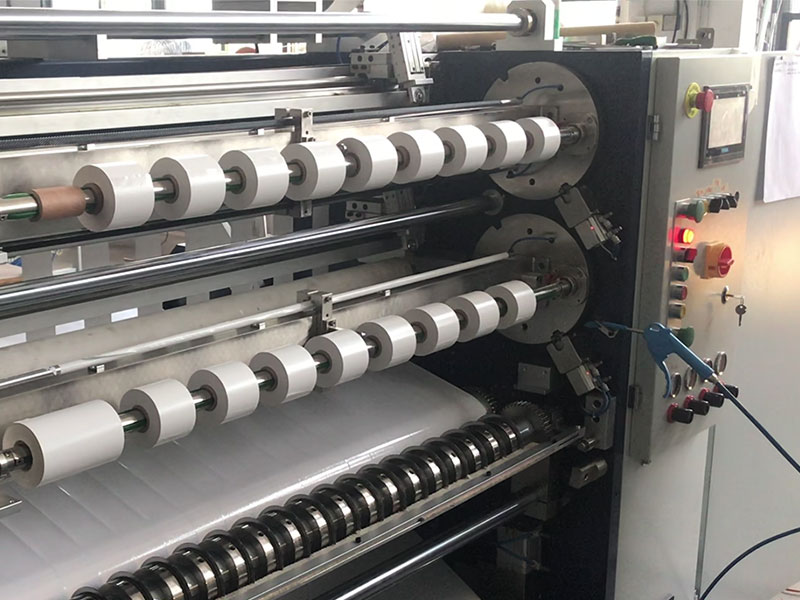
2. Closed-loop tension control and automatic deviation correction system
In the process of slitting, single-sided tape must withstand the tension of multiple links such as unwinding, rolling, and winding. Tension fluctuations are the biggest hidden killers of deteriorating width accuracy and uneven reeling.
1. Automatic closed-loop tension control: Tension sensors are installed on the unwinding shaft, traction roller and rewinding shaft respectively to detect the actual tension of the tape in real time and compare it with the target value set by the controller. The controller achieves dynamic balancing by adjusting the damping of the unwinding motor or the torque of the rewinding motor. For example, when the diameter of the master coil is reduced from 1 meter to 0.2 meters, the system automatically reduces the unwinding braking force to ensure that the tape is always in constant tension before entering the slitting knife, avoiding narrowing the slitting width due to tensile deformation.
2. Ultrasonic/photoelectric correction system: When the tape master coil is unwinded at high speed, it will produce a lateral "snake" oscillation due to the uncircularity of the coil itself or the uneven thickness of the material. If the swing amplitude exceeds the allowable range of the slitting knife, the width of the cutting tape will inevitably be excessive. High-sensitivity ultrasonic correction sensors are installed in the unwinding frame and the front section of the slitting section (especially effective for transparent or translucent single-sided tapes) to detect the edge position of the tape in real time, and the unwinding frame is moved laterally by servo drive to control the swing within ±0.5mm to ensure that the tape always enters the knife edge in a standard trajectory.
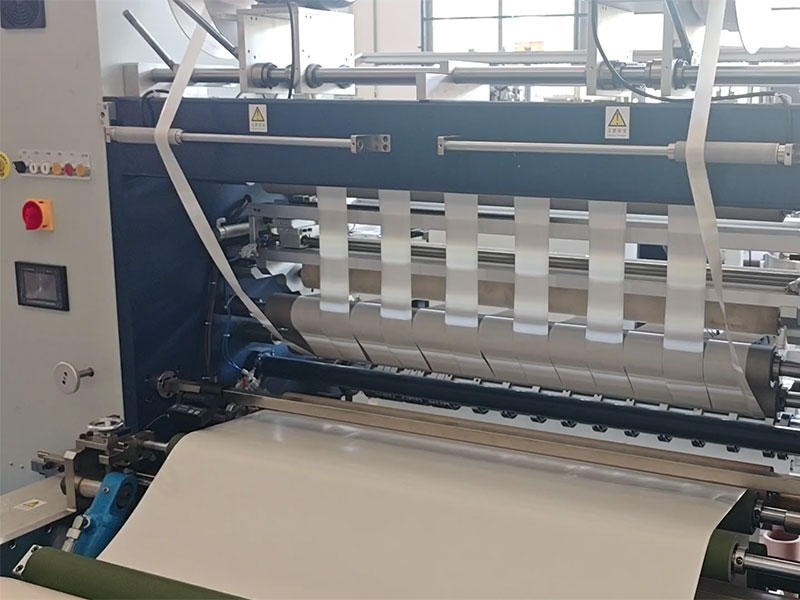
3. Intelligent servo drive and PID parameter self-tuning
The response speed and control accuracy of the slitting action ultimately depend on the optimization of the drive system and core algorithm.
1. Multi-axis servo independent drive: The traditional slitting machine uses a main drive shaft to drive all winding stations through gears or chains, but the disadvantage is that the speed will be out of sync between each station. Modern high-precision equipment adopts servo motors independently configured for each winding shaft, combined with the electronic gear synchronization function, so that the winding line speed of each station is accurately synchronized with the speed of the host. Even if more than 30 narrow strips of tape are slit, the linear speed error of each core can be controlled within 0.1%, eliminating the phenomenon of "inner loosening and external tightness" or pulling broken caused by speed difference.
2. Dynamic pressure adjustment of the winding roller: When the single-sided rubber is slitted and rewinded, as the roll diameter increases, it is necessary to apply a linearly increase in pressure through the roller to expel the air between the layers to prevent wrinkles or end face misalignment. The advanced slitting machine adopts a closed loop with a proportional air valve and pressure sensor to adjust the pressure of the roll in real time so that it changes in a preset curve with the roll diameter, so as to ensure consistent end face neatness from minimum to full roll.
3. PID parameter adaptive technology: The elastic modulus and friction coefficient of single-sided adhesives (such as oil, hot melt, and water adhesives) of different formulations vary greatly. The high-end controller has a built-in PID parameter self-tuning module, which can quickly identify material characteristics during the trial cutting stage, automatically match the optimal tension, acceleration and brake slope to avoid loss of accuracy caused by improper manual setting.
Epilogue
The improvement of the accuracy of single-sided adhesive slitting machine does not rely on the improvement of a single component, but is the result of the synergy of three technologies: "rigid tool holder system, closed-loop tension control, and intelligent servo drive". For tape manufacturers, investing in slitting machines with the above technologies seems to increase the initial cost, but in exchange for lower material loss, higher yield, and the ability to process thinner, narrower, and higher value-added tapes, thus building technical barriers in the fierce market competition. In the future, with the integration of machine vision and edge computing technology, the slitting accuracy will continue to evolve in the direction of "micron-level, fully automatic real-time correction".
 English
 Deutsch
 Français
 Español
 Português
 日本語
日本語 русский
 한국어
한국어 عربي
عربي ภาษาไทย
 Tiếng Việt
 Italiano
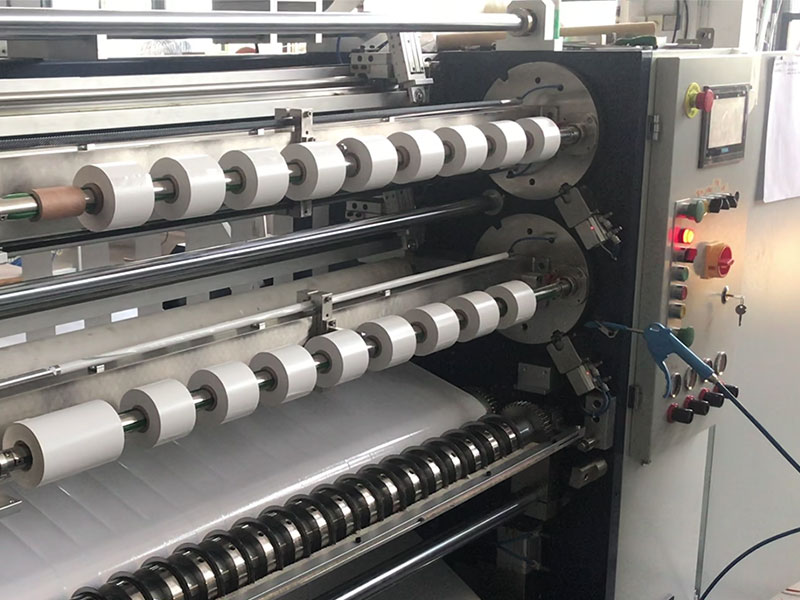
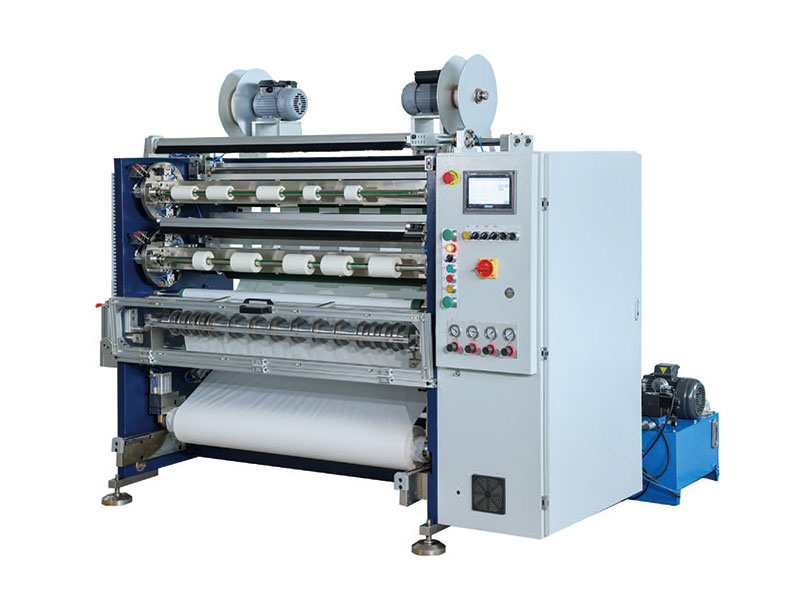 Single Side Adhesive Slitter