In industrial production, long-term operating costs are often hidden in everyday details. For solar film manufacturers, the slitting process is the last process before the finished product leaves the factory, and the control of energy consumption and loss directly determines the profit margin of the product. As the core equipment of this link, the energy-saving design of the solar film slitting machine is not only a technological innovation, but also a key strategy to help enterprises build a cost moat.
This article will explore how solar film slitting machines can reduce long-term operating costs through energy-saving design from the dimensions of power system, waste treatment, heat loss control, and intelligent management.
1. Efficient servo drive and energy recovery: say goodbye to ineffective work
Traditional slitting machines often use asynchronous motors with mechanical brakes for tension control, and in the process of frequent starting and deceleration, a large amount of electrical energy is consumed on the brake resistor and converted into useless heat energy.
Modern energy-saving solar film slitting machines generally use full servo direct drive technology. Servo motors have the characteristics of fast response and high precision, and will only operate at high power when torque is required, and the energy consumption in standby mode is extremely low. More importantly, the advanced common DC bus technology allows the motor to convert to the generator state when the equipment decelerates the unwinding shaft, and the generated regenerative energy can be directly utilized by the winding shaft that is accelerating in the same system.
This "energy internal circulation" design reduces the waste of energy on the brake resistance. According to actual production data, compared with traditional models, servo slitting machines using energy recovery can save 25% to 35% of electricity under frequent start-stop conditions. For enterprises that need to produce continuously in three shifts, this part of the electricity cost savings can often cover the difference in equipment procurement within one year.
2. Shaftless design and short path: reduce mechanical loss and friction
The efficiency of mechanical transmission directly affects energy consumption. The longer transmission path of traditional slitting machines not only increases energy loss but also introduces maintenance costs.
1. Shaftless top cone clamping
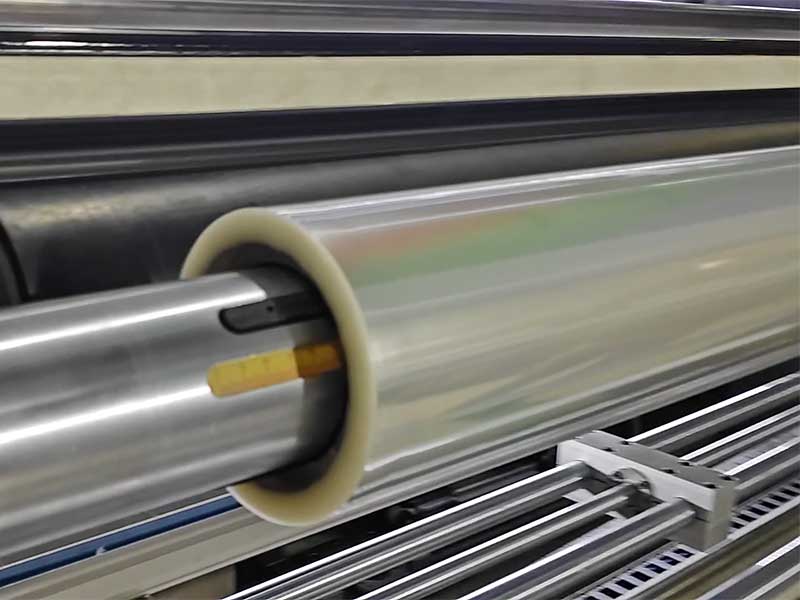
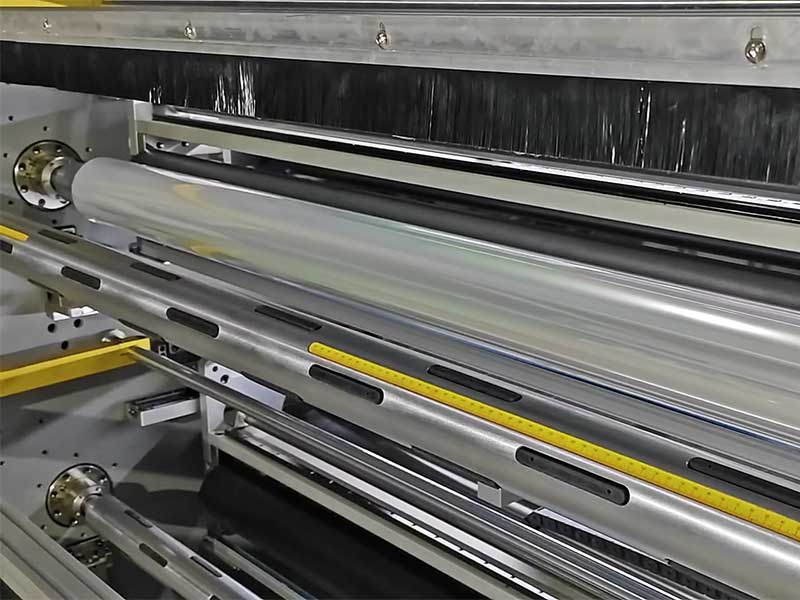
Modern energy-saving models mostly adopt shaftless design, and directly clamp the film coil through the pneumatic top cone. This design reduces intermediate transmission links, resulting in higher transmission efficiency and reduced drag due to mechanical wear.
2. Shorten the transfilm path
By optimizing the swing arm structure and roller layout, the new slitting machine significantly shortens the film penetration path. The shorter the path, the less air resistance and roller friction the film is subjected to during operation. This not only reduces the need for traction, which lowers the load on the motor, but also reduces the risk of scratches on the film surface due to friction and reduces scrap rates.
3. Margin material recycling system: a closed-loop economy that turns waste into treasure
In the process of solar film slitting, the treatment of sedges is a long-neglected energy consumption point. The traditional method is to blow the edge material into the aggregate box through a high-pressure fan, which often runs at full capacity, and the long-distance conveying pipeline has high resistance and amazing power consumption.
Energy-efficient slitting machines are usually equipped with a central dust collection system with high negative pressure and low air volume or an in-line crushing and reuse system:
• Crushing in place: The slitting machine is directly connected to the crushing machine, and the edge material is crushed immediately after it is generated and transported to the recycling bin through a closed pipeline. This reduces energy consumption during material handling.
• Frequency conversion control: According to the width and weight of the edge material, the speed of the fan is automatically adjusted to avoid the phenomenon of "big horse-drawn cart".
This design not only greatly reduces the power consumption of the fan, but more importantly, recycles the waste into pellets in a timely manner, reducing the waste of raw materials. For expensive automotive film or construction film substrates, the increase in scrap recycling rates translates directly into an increase in net profit.
4. Intelligent temperature control and standby mode: reduce hidden waste
Many solar film slitting machines require heating of the rollers to keep the rollers sticky or to handle special coatings. Energy-saving design is mainly reflected in two aspects:
• High-efficiency thermal oil/electric heating roller: Thermal oil rollers with special runner design or electric heating rollers with precise temperature control have better temperature uniformity and less thermal inertia than traditional heating methods, which can quickly reach the set temperature and reduce warm-up time.
• Automatic sleep function: When the equipment is in a state of waiting material, rewinding or a short period of shutdown, the system can automatically cut off the auxiliary heating system and switch the main motor to sleep mode. This kind of "peak shaving and valley filling" energy consumption management avoids ineffective loss of energy during non-productive periods.
5. Lean cutting: reduce energy consumption from the source
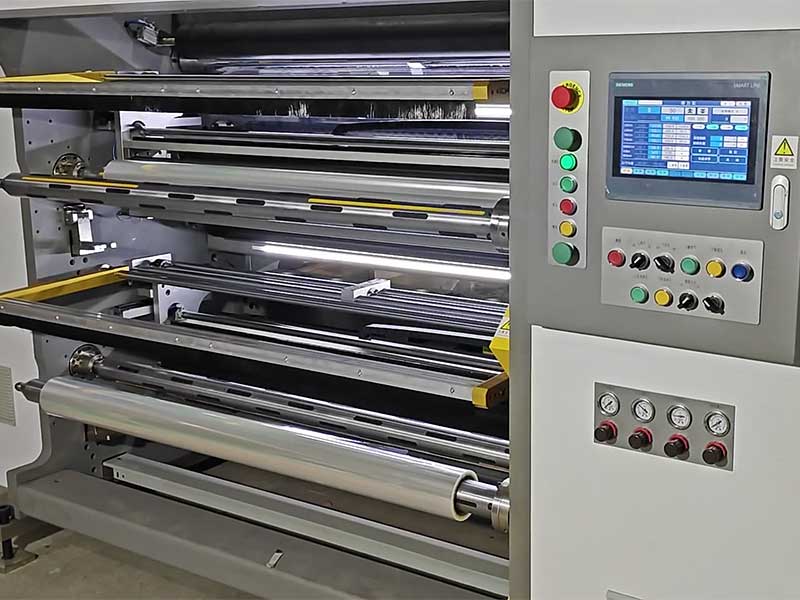
Energy saving lies not only in the operation of the equipment itself, but also in the source of process design. The control system of modern slitting machines integrates intelligent slitting algorithms. The operator only needs to enter the master roll width, finished product specification and order quantity, and the system will automatically calculate the slitting scheme with the lowest loss rate.
By optimizing the knife row, the effective width of the master coil is maximized, and the width of the edge material is reduced, which is actually a "secondary saving" on the several tons of raw materials and huge energy consumption consumed in the production of master coils. This kind of "soft energy saving" achieved through software algorithms is often the most cost-effective means of cost reduction.
Epilogue
The energy-saving design of solar film slitting machines is not just to meet environmental compliance requirements, but also a set of economic considerations throughout the life cycle of the equipment. From motor drive to scrap recycling, from thermal management to intelligent production scheduling, the optimization of every link is accumulating competitive advantages for enterprises.
In today's world of raw material price fluctuations and increasingly fierce market competition, investing in an energy-efficient slitting machine is essentially investing in a more resilient production method. It gives companies more buffer space and pricing initiative in the face of cost pressures. When every kilowatt-hour of electricity is used to create value and every slitting is close to zero loss, the long-term operating costs of the enterprise are naturally kept to a minimum.
 English
 Deutsch
 Français
 Español
 Português
 日本語
日本語 русский
 한국어
한국어 عربي
عربي ภาษาไทย
 Tiếng Việt
 Italiano
 Solar Film Slitter