During the solar film slitting process, static electricity is an invisible "invisible killer." High-speed unwinding, roller shaft friction, film stripping—every action generates high-voltage static charge. Operators being electrocuted is a minor issue, but what's even more troublesome are dust adsorption on the film surface causing scratches, coating damage caused by static electricity breaking down and affecting optical performance, and even uneven winding caused by static repulsion during winding. The root cause of the problem is often the same: after static charge accumulates, there is no smooth discharge channel.
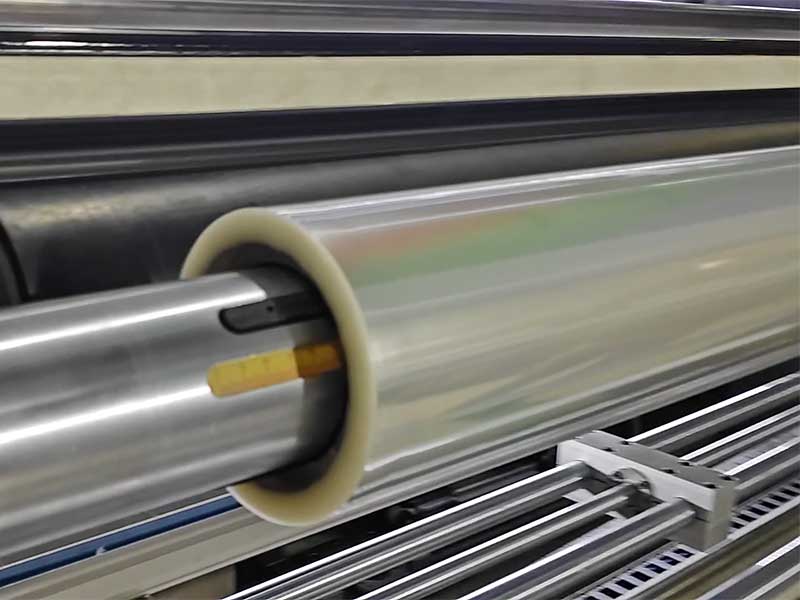
Where does static electricity come from, and what does it cause?
During operation, the sun film (especially PET substrate or TPU material) rubs at high speed against the guide roller, generating a large amount of static charge. If the equipment itself is not properly grounded, these charges will accumulate on the frame, roller shaft, and even the diaphragm surface. When static electricity accumulates to a certain level, it can absorb dust particles in the air at best, causing scratches or impressions on the film surface; In severe cases, electrostatic discharge can occur, breaking through the functional coating of the solar film and causing optical distortion or performance degradation. Experienced craftsmen know that during the dry season, static electricity issues multiply exponentially.
Grounding is the foundation of the entire solution
Grounding isn't a new technology, but getting it right isn't easy. The core concept is to establish a low-impedance path for static electricity, allowing charge to be continuously and safely introduced into the earth.
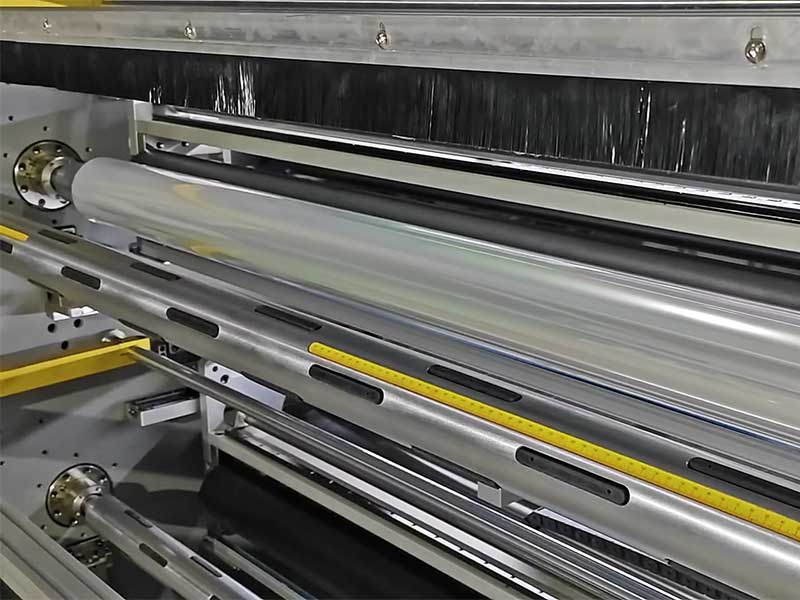
The specific approach is divided into three levels:
First layer: Equipment frame grounding. This is the most fundamental step. The frame of the slitting machine is reliably connected to the grounding electrode buried underground via the grounding wire. The grounding electrode is usually made of galvanized angle steel or copper rods, and the burial depth must meet the grounding resistance requirement (generally less than 4Ω). After the rack is grounded, frictional static electricity generated during equipment operation will continue to be transmitted into the ground through the grounding wire, preventing charge accumulation on the machine body and fundamentally eliminating the risk of electric shock for operators.
Layer 2: Equipotential connection of rotating parts. Many manufacturers ground the frame but neglect rotating parts such as the roller shaft and blade shaft. These components rotate at high speed and are in direct contact with the film surface, making them the main sources of static electricity. If there is a potential difference between them and the frame, static electricity cannot be dissipated. The patent technology mentions that placing conductive plates at the press or connecting plate to keep them in contact with rotating parts and then routing them underground via ground wires can effectively eliminate static electricity at rotating parts. This approach is equivalent to "pulling" all metal parts onto the same electric potential, leaving static electricity nowhere to hide.
Third layer: Passive grounding combined with active elimination. Grounding can solve the static discharge problem of the equipment itself, but auxiliary measures are needed for the static electricity carried by the membrane itself. Static elimination rods (ion air bars) are installed above the winding roller or after unwinding, generating positive and negative ions through high-voltage ionization of the air, neutralizing the static charge on the membrane surface. This complements grounding, which is a "one active, one passive" relationship—grounding dispels charge from the equipment, while ion rods neutralize charges on the membrane surface. Only by working together can comprehensive control be achieved.
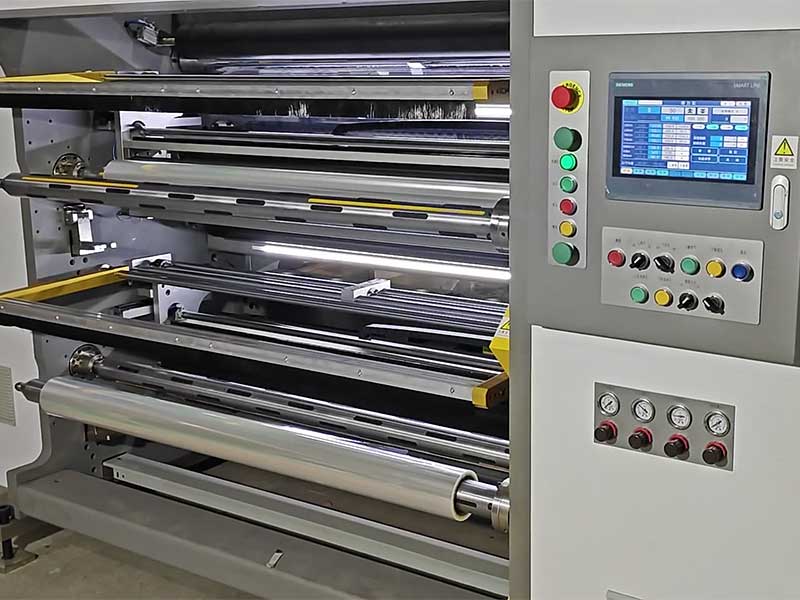
What else should a complete electrostatic control solution focus on?
Even with grounding and ion bars, the effectiveness may still be compromised, often due to environmental factors. When workshop humidity is controlled at 50%~60%, the air itself has a certain degree of conductivity, which helps the natural dissipation of static charge. In dry winters, you can consider using a humidifier to assist with humidification. Additionally, static elimination devices are installed at key nodes before and after slitting, and the conductivity and resistance of the grounding wire are regularly checked to ensure the grounding system remains effective.
Conclusion
The answer to the static electricity problem of the solar film slitting machine does not lie in a "magic device," but in a systematic grounding solution: frame grounding is the foundation, equipotential connections of rotating components are key, neutralization by ion air rods is supplementary, and environmental humidity control is the guarantee. This solution requires little investment, but it effectively prevents film surface scratches, electric shock hazards, and poor winding caused by static electricity, making it worth every film slitting enterprise putting into serious practice.
 English
 Deutsch
 Français
 Español
 Português
 日本語
日本語 русский
 한국어
한국어 عربي
عربي ภาษาไทย
 Tiếng Việt
 Italiano
 Solar Film Slitter